


Advice
Do You Need a Mat Under an Indoor Bike or Rower? Floor Protection Explained
If you are putting an exercise bike or rowing machine in a spare room, living room or garage, a mat can help protect the floor — but not every setup needs one, and not every mat is suitable. The main question is not simply whether the machine is heavy. It is whether the machine marks, compresses or wears the surface through its contact points, slight movement in use, and sweat or debris building up underneath. In most home setups, dense rubber gym matting is a better choice than a normal indoor door mat.

An indoor bike or rower does not always need a mat underneath. Some home setups are low risk, especially if the machine is used lightly and stays completely stable. But many people use a mat because the real issue is not just weight — it is repeated contact in the same spots, slight shifting during use, and sweat or grit reaching the floor.
If you are trying to avoid marks, compression or wear, the best approach is to judge the risk by machine type, how often you use it, how much it moves, and what surface it is standing on. That matters more than buying the thickest mat you can find.
When a mat is worth using
A mat is usually worth considering if your bike or rower has small or firm contact points, if it rocks or creeps slightly during use, or if it sits in a room where you want to keep the floor cleaner and easier to maintain. Rowers can be a particular case because the repeated push-pull action may create slight movement even if the machine does not obviously travel across the floor.
On carpet, the concern is often compression and wear where the machine sits. On hard floors, people tend to worry more about marks or abrasion from tiny amounts of movement over time. In a garage, the question is often less about appearance and more about creating a practical exercise area that is easier to keep clean and better suited to equipment.
Signs your setup is higher risk
- The machine has narrow feet or hard contact points.
- It shifts slightly when you get on, off or change pace.
- You use it regularly rather than occasionally.
- Sweat, dust or small debris may collect under the machine.
- You are placing it in a finished room where visible marking matters.
What kind of floor damage can actually happen?
For most home users, the realistic risks are fairly simple. First, the machine can leave marks where it sits. Second, the floor covering can compress where the load stays in one place. Third, even a very small amount of repeated movement can wear the surface over time. Finally, sweat and general debris can build up under and around the machine, which makes the area harder to keep tidy.
This is why a mat can help even when the machine does not seem especially heavy. Protection is often about creating a more suitable interface between the equipment and the floor, not just adding a soft layer.
It is also worth separating floor protection from other reasons people mention mats. This article is about protecting the surface underneath your bike or rower, not about performance, cushioning or other benefits that may depend on the machine and room.
Why a normal indoor door mat is usually the wrong choice
A common question is whether a spare household mat will do the job. In most cases, a normal indoor door mat is not the best option under an exercise bike or rowing machine. That includes the familiar rubber-backed, carpet-surface mats used near entrances.
Those mats are designed mainly for dirt and moisture control at doorways. They are not intended as a base for static exercise equipment that stays in place and is used repeatedly. They may be the right product by the front door, but that does not make them suitable beneath a cardio machine.
The same logic applies if you were already looking at entrance mats for general floor protection. Their intended use is different.
Will a rubber-backed carpet mat suffice?
Usually, no. It may look protective because it has a soft top and rubber backing, but that does not mean it will stay stable or cope well with repeated equipment use. For a bike or rower, the better comparison is not with an entrance mat at all, but with gym matting designed for exercise areas.

What type of mat is better under a bike or rower?
For most home cardio setups, dense rubber gym matting is the more suitable category. It is designed for exercise spaces and is generally a better fit for repeated machine use than household mats made for entrances or general domestic flooring.
The key things to look for are density, stability, enough coverage for the full machine footprint, and a format that is less likely to creep out of place. Thickness matters, but it is not the only buying criterion and should not be the main one on its own.
Suitable matting types
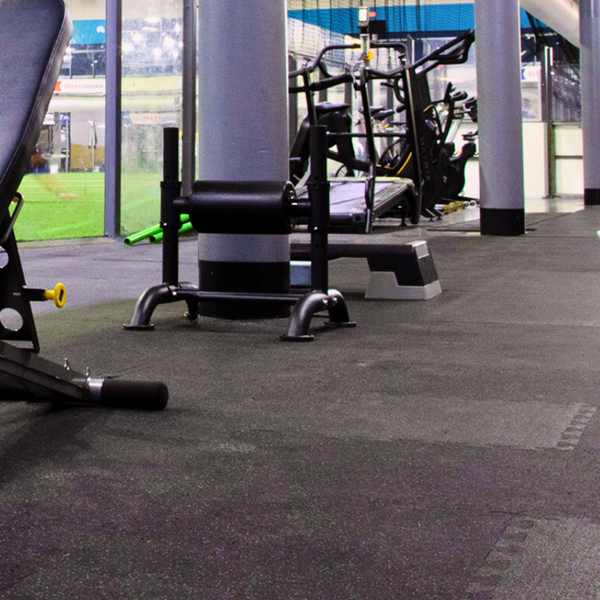
Standard home setups often suit interlocking rubber gym tiles or a large dense rubber gym mat. These are the sorts of products people use under cardio equipment in home and garage gym areas because they are intended for that environment.

In most cases, they don't need to be overly thick or heavy; around 10mm will be plenty. Even so, a single large mat would be heavy and awkward to move, so look for interlocking tiles. Most of these measure 60cm x 60cm and weigh about 5kg each.
Rubber Gym Mat Tiles
Standard Rubber Gym Mat Tiles provide a tough, long-lasting surface for home gyms, garage conversions, and weight training areas. Made from dependable heavy-duty rubber, they are far more hardwearing than…
- Interlocking System: Easily connects for a stable workout surface.
- Floor Protection: Cushions impact from dropped weights.
- Slip-Resistant Texture: Enhances grip for safer workouts.
- Bevelled Edges: Reduces trip hazards and provides a smooth transition.
From £22.10 + VAT
If the space is used more heavily, or you want a more robust gym-style surface for a busier cardio zone, a heavier-duty rubber tile can make more sense. The important point is the category: dense rubber gym matting, rather than a household entrance mat. These will be thicker, around 18mm to 20mm, but also larger and weighing over 10kg each.
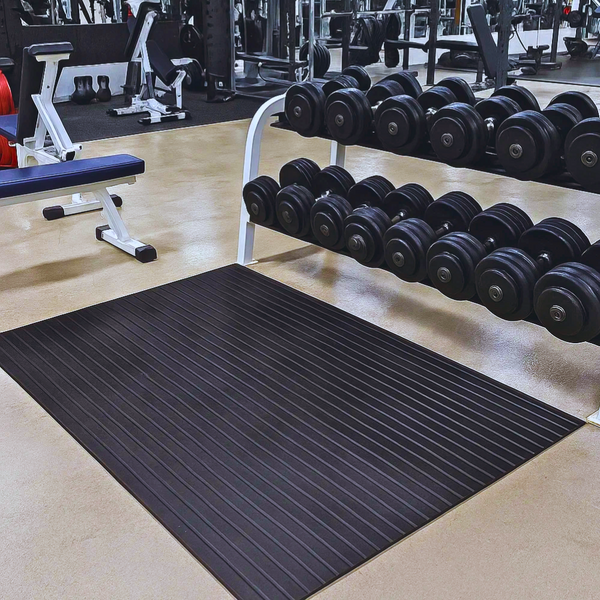
If you prefer a single large-format mat rather than tiles, a large dense gym mat can also be a practical option, provided it properly covers the machine area and stays in place. These measure 120cm x 180cm and 12mm thick versions weigh around 26kg.
Heavy-Duty Weight Lifting Mats
Protect Floors with Heavy-Duty Weight Lifting Mats Heavy-Duty Weight Lifting Mats: These robust mats are designed to cushion the impact of weight lifting activity, making them ideal for both home…
- Superior Floor Protection: Prevents damage from dropped weights.
- Shock-Absorbing Design: Reduces noise and impact during training.
- Non-Slip Surface: Improves grip for a safer workout experience.
- Versatile Thickness Options: Available in 12mm and 17mm.
From £73.12 + VAT
Mat types to avoid
Coir mats are not a good match under an indoor bike or rower. They are made for entrance use and debris capture, not for supporting exercise equipment. They are the wrong material and the wrong format for this job.
Foam-style yoga mats are also a poor choice in many home cardio setups. They may seem convenient, and are cheap to buy, but they are intended for light workouts rather than to support equipment. For floor protection beneath bikes and rowers, dense rubber is usually the safer category to focus on.
Common buying mistakes
- Choosing a mat because it is thick, without checking whether it is dense and stable.
- Buying a mat that is too small for the machine footprint and use area.
- Assuming any rubber-backed household mat will do.
- Ignoring sweat and debris that build up around the equipment.
- Not noticing that the mat itself creeps or shifts in use.
How to choose without overbuying
If your bike or rower is used occasionally, stays very steady and sits in a low-risk space, you may decide that a mat is not essential. But if you can see even small amounts of movement, or you want a more practical protective layer under the machine, dense rubber gym matting is usually the sensible middle ground.
For a spare room or living room, the aim is usually simple floor protection without turning the whole room into a gym. For a garage, interlocking rubber tiles often suit the space well because they can define a clear workout area. This garage example shows how gym mat tiles can be used to protect the floor in a practical exercise setting.
Practical care notes
If you choose rubber gym matting, a practical point to be aware of is that some rubber mats may have an odour when new. If that matters in your room, allow time for ventilation. Keep the area clean, and use a pH-neutral cleaner where needed. After cleaning, let the mat dry properly and keep the space ventilated.
In short: a mat is not automatically required under every indoor bike or rower, but a normal indoor door mat is usually the wrong tool for the job. If you do need protection, dense rubber gym matting is generally the more suitable option because it is designed for exercise areas rather than entrances.