Buying Guides
Fire Resistant Matting for Communal Areas

Why standard doormats are banned, and how housing providers can solve the problem without upsetting residents
Across the UK, housing officers and building managers are dealing with what many now call the “doormat wars.” Residents want a small mat outside their front door for cleanliness and a sense of home. Safety officers, inspectors, and fire risk assessors want those same mats removed because in communal corridors, they create both trip hazards and fire risk.
Under current fire safety legislation, both sides are partly right. The challenge for the “Responsible Person” is finding a solution that keeps escape routes safe and maintains a reasonable living environment. This is where a managed approach, rather than a blanket ban, can make sense. This article, by the experts at First Mats, explains what you need to do.
The Risk: Why a £5 Doormat Becomes a Serious Hazard
In private homes, a standard coir or rubber-backed doormat is harmless. In a shared corridor or communal entrance, it becomes something very different.
The primary risks are:
- Fire load: Natural coir, rubber, and cheap synthetic mats are combustible. In a fire, they can ignite, contribute to flame spread, and generate dense, toxic smoke.
- Escape obstruction: During an evacuation, loose mats can be kicked up or folded, physically blocking an escape route when visibility is already compromised.
- Trips and falls: Raised edges and thick pile increase the risk of falls, particularly for older residents or those with mobility impairments.
This is why many fire risk assessments default to a “zero tolerance” position: remove all personal items from communal areas. In practice, however, this approach is difficult to enforce and often leads to ongoing conflict with residents.

The Rules: What the Law Actually Requires
The Regulatory Reform (Fire Safety) Order 2005
The legal foundation for clear corridors comes from Article 14 of the Regulatory Reform (Fire Safety) Order 2005 . It requires that routes to emergency exits, and the exits themselves, are kept clear at all times.
This is the provision most commonly cited when standard mats are removed during inspections. If an item can obstruct escape or add fire load, the Responsible Person is expected to control it.
The Fire Safety (England) Regulations 2022
The Fire Safety (England) Regulations 2022 strengthened this position following the Grenfell Tower Inquiry. They place explicit duties on Responsible Persons in multi-occupied residential buildings, including regular checks of fire doors and communal areas.
As a result, inspectors are now paying closer attention to corridor conditions. Floor coverings, previously overlooked, are increasingly scrutinised as part of routine compliance checks.
“Zero Tolerance” vs. “Managed Use”
The practical reality of managing housing stock is acknowledged in official guidance. The Local Government Association’s guide to Fire Safety in Purpose-Built Blocks of Flats (often treated as the sector’s reference manual) discusses this directly.
In Section 41.6, the guide recognises that:
- Keeping communal areas completely clear is the safest option in theory.
- In practice, a strict “zero tolerance” policy is difficult to police and can undermine resident cooperation.
- A managed approach that allows only low-risk, controlled items, can be more effective.
This is the space where certified, purpose-designed matting becomes relevant. Instead of saying “no mats,” housing providers can say: “Yes, but only mats that meet defined fire and safety criteria.”

Understanding Fire Ratings: What “Cfl-s1” Actually Means
Fire safety terminology can be opaque, but for communal flooring, one classification matters most: Cfl-s1.
This rating comes from the European fire classification system defined in EN 13501-1. A plain-English breakdown:
- Cfl – The material is combustible but makes a limited contribution to fire. It does not readily ignite or allow flames to spread across the surface.
- s1 – Smoke emission level 1. This is the lowest smoke production category, which is critical because smoke inhalation, not flames, is the leading cause of death in building fires.
For a deeper explanation of the Euroclass system, see: EN 13501-1 fire classification explained .
The UK context: BS 4790 (“Hot Metal Nut” test)
Historically, UK flooring was also assessed using BS 4790, commonly known as the “hot metal nut” test. A steel nut heated to around 900°C is placed on the carpet to observe whether the char spreads.
While newer Euroclass testing has largely superseded it, understanding BS 4790 helps explain why some older mats fail modern fire risk assessments. A clear, non-technical overview of the test can be found here: Why fire ratings are essential (BS 4790 explained) .
The Practical Solution: Dura-Plush for Communal Areas
For housing associations, councils, and managing agents, the ideal mat for communal areas must solve three problems at once: fire safety, slip risk, and resident acceptance.

Dura-Plush flame retardant entrance mats by First Mats are designed specifically for this context.
- Cfl-s1 certified: meets the key fire performance requirement for communal flooring, giving safety officers a clear compliance benchmark.
- Low-profile construction: reduces trip risk compared to thick coir or domestic mats.
- Anti-slip vinyl backing: keeps the mat in place during normal use and emergencies.
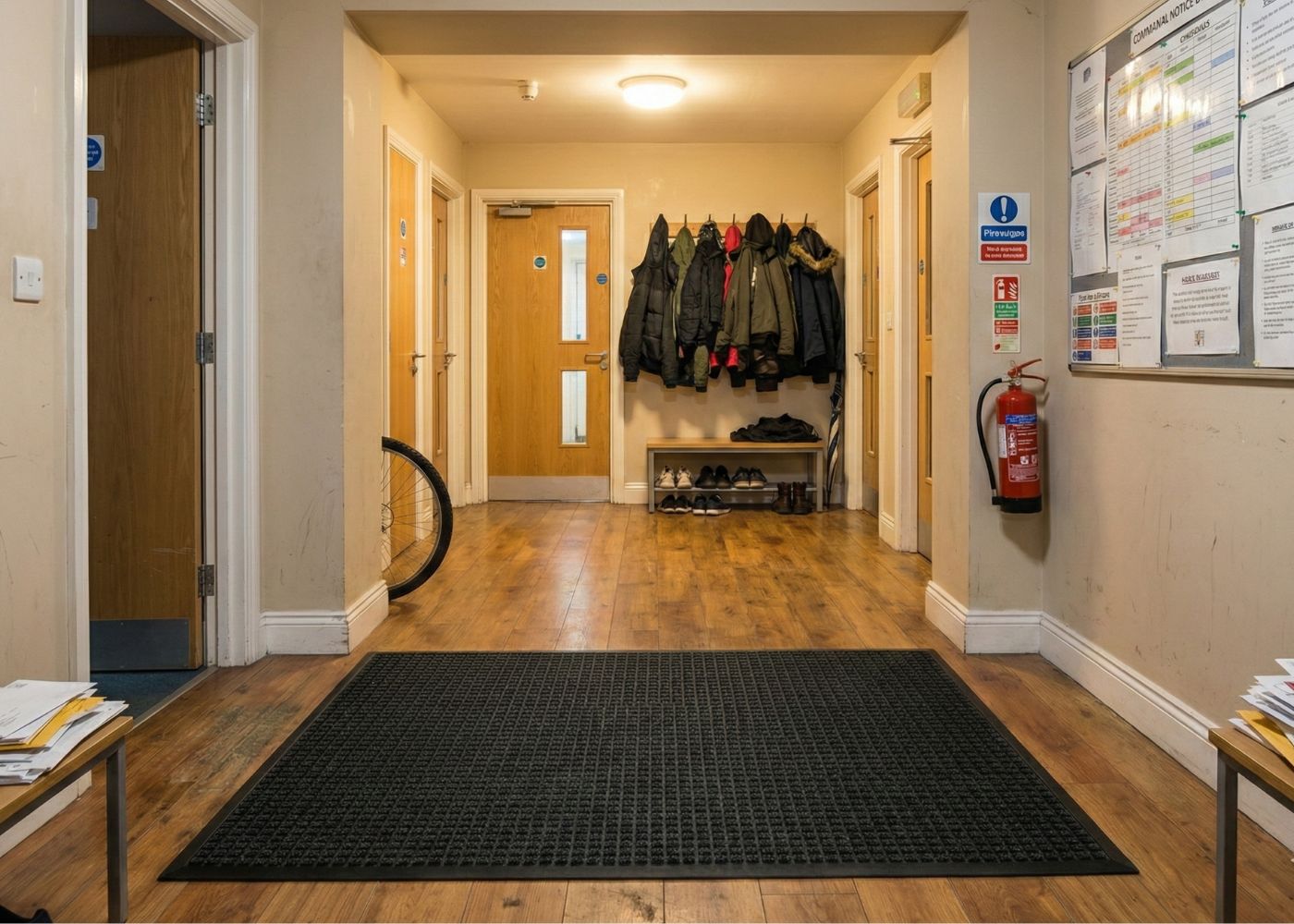
- Domestic appearance: looks like a conventional carpet mat rather than an industrial rubber product, supporting resident comfort and cooperation.
In effect, First Mats' Dura-Plush allows Responsible Persons to replace an unmanageable “no mats” rule with a clear, enforceable policy: only approved, fire-rated mats are permitted in communal areas.
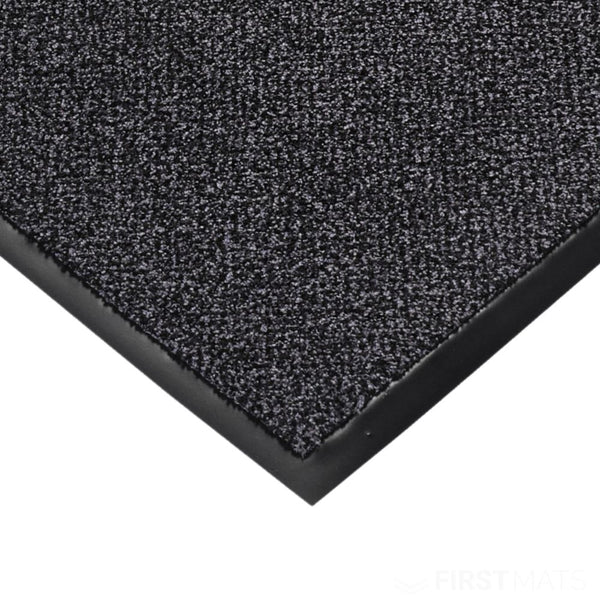
Dura-Plush Flame Retardant Door Mat
The Dura-Plush Flame Retardant Door Mat is designed to meet strict fire safety standards, making it a reliable choice for housing associations, local councils, and multi-occupancy buildings. Fully certified to…
- Flame Retardant: Certified to Cfl-S1 standards for fire safety.
- Durable Fibres: Hard-wearing polyamide pile ensures long-lasting performance.
- UV Resistant: Maintains vibrant colours even in direct sunlight.
- Anti-Slip Backing: Vinyl backing keeps the mat securely in place.
From £34.62 + VAT
For wider context on entrance matting types, see: Entrance Matting
Communal Matting Checklist (For Procurement & Safety Officers)
- Fire rating: Is the mat certified to Cfl-s1 under EN 13501-1? (If not, it should not be in a communal escape route.)
- Trip profile: Is the mat low-profile with no raised edges that could catch feet?
- Slip resistance: Does the backing prevent the mat from sliding under normal foot traffic?
A mat that meets all three criteria supports compliance, reduces ongoing enforcement disputes, and improves resident satisfaction, without compromising fire safety. For more information, contact the team at First Mats, who can guide you further.