Buying Guides
Which Mats Should Be Used in Data Centres?

Data centres have very different requirements from most working environments when it comes to floor mats. While entrance mats are typically designed to scrape off dirt and absorb moisture, server rooms and white spaces demand a far higher level of control. Here, the priorities shift to limiting fine dust and particles that can be drawn into equipment, while also managing static electricity so people can work safely around sensitive hardware.
At First Mats, we work with organisations that need matting products suited to controlled environments, where poor material choice can introduce risk rather than reduce it. When specified correctly, the right mats help protect equipment, support maintenance activity, and reduce contamination entering critical areas.
Used well, data centre matting supports two essential objectives:
- Contamination control, by capturing fine debris from footwear and wheeled equipment before it circulates through airflow and filtration systems
- Static control (ESD), by helping dissipate electrostatic charge when the mat is correctly specified and grounded
Used incorrectly, however, the wrong mat can do more harm than good, by shedding fibres, releasing trapped contaminants back into the air, or encouraging static build-up. This guide explains how to choose appropriate floor mats for data centres, and why material choice, construction, and specification matter.

Start with a simple map of your data centre
Before choosing products, the experts at First Mats suggest tackling one zone at a time. Most sites naturally split into:
- Entry points: doors into the white space, airlocks, gowning areas, and any access routes used by contractors.
- Work areas: benches, crash carts, staging points for unboxing, labelling, inspection, or repairs.
- Routes and thresholds: where temporary cabling is used, where raised floor transitions occur, and where trip risks are highest.
- Electrical areas: switchgear rooms and UPS panels (often separate from the white space).
Once you know the zones, it becomes much easier to match the right type of mat to each one.
Mats to use in data centres
1) Tacky (sticky) mats for entrances and access points
Tacky floor mats are a strong first step for contamination control because they’re designed to capture fine particles from footwear and wheels as people enter the controlled area. They’re most effective when placed at every entrance into the white space, including staff doors and contractor access routes.

There are two common approaches:
- Peel-off tacky mats: multi-layer adhesive film. When the top layer becomes contaminated, you peel it away to reveal a fresh surface. This is easy to manage day-to-day and suits sites that want a quick, visible routine.
- Washable polymeric tacky mats: naturally tacky polymer mats intended for longer-term use. These can capture fine debris well, but they rely on a consistent cleaning schedule to keep performance steady.
[rec:tacky-mats]
What to watch: tacky mats only do their job if the top surface is maintained. If peel-off layers aren’t changed, or polymer mats aren’t cleaned, the entry point becomes a “collection area” rather than a control point.
2) ESD mats for workbenches, staging, and maintenance tasks
Wherever staff handle components, install hardware, or work at a crash cart, you should treat it as an ESD-sensitive task area. That’s where ESD dissipative or conductive mats come into play.

Key points for ESD matting:
- They must be grounded: ESD matting is intended to dissipate charge safely to earth, but only works as designed when installed and connected correctly.
- Match the mat to the task: a bench or staging area may need a different format to a floor standing position.
- Choose permanent performance over “coatings”: matting that relies on a temporary surface treatment can become unreliable as it wears.
For teams who stand for long periods while working at racks or benches, First Mats recommend using ESD anti-fatigue mats, which can add comfort while still supporting static control requirements (again: correct grounding is essential).
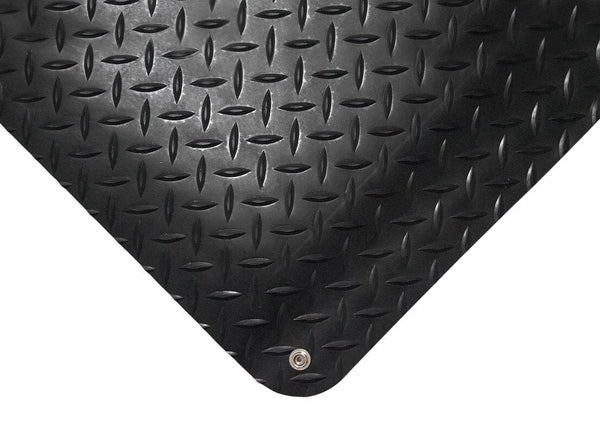
Anti-Static Industrial Heavy-Duty ESD Deck-Mat
Heavy-Duty ESD Deck-Mat: Unmatched Safety & Comfort Enhanced Worker Safety: Our Anti-Static Industrial Heavy-Duty ESD Deck-Mat is designed to safeguard both personnel and equipment in demanding industrial settings. Robust Anti-Fatigue…
- Anti-Static Safety: Protects workers and sensitive equipment in high-voltage environments.
- Slip-Resistant Surface: Diamond-patterned surface with 2/3 slip resistance rating.
- Exceptional Durability: Rated 3/3 for wear resistance to withstand heavy use.
- Comfortable Design: 14mm thick mat with superior anti-fatigue properties.
From £143.43 + VAT
Standards note: IEC 61340-5-1 is widely used for ESD control programme requirements and is a helpful reference point when setting up ESD-safe handling areas and procedures.
3) Cable protection for safer routes (and fewer “temporary” hazards)
Even well-run data centres end up with temporary leads during installs, testing, or maintenance. Loose cables can quickly become a trip hazard, particularly around doors, thresholds, and staging areas. They can also be damaged by trolleys and foot traffic.

That’s where floor cable protectors help: they create a clearly defined crossing point, protect the cable itself, and make the route more predictable for anyone moving through the area.
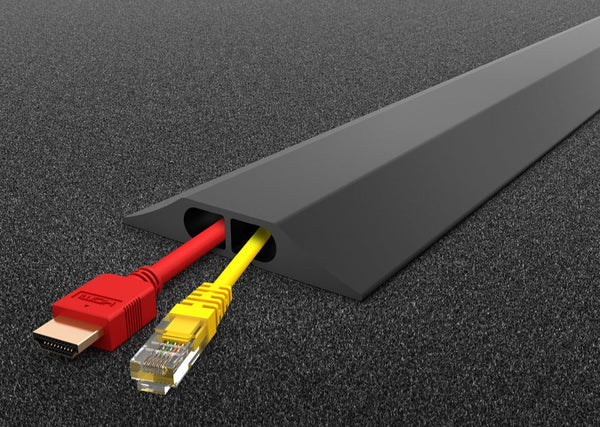
Dual Channel Data Cable Protector - 3m Long
3 Metre Data Cable Protectors with Dual Channels and Secure Seam Design Extended Length Coverage: 3 metres of robust protection to accommodate a variety of cable management needs. Dual Channel…
- Long 3m Coverage: Provides extended cable protection in offices and warehouses.
- Dual Channel Design: Keeps cables separated and secure.
- High-Quality PVC: Durable and suitable for both indoor and outdoor use.
- Trip Hazard Reduction: Keeps cables safely stored and out of the way.
From £43.82 + VAT
Tip: keep cable crossings to a minimum, and position protectors so they don’t interfere with door swing, rack access, or emergency egress routes.
4) Dielectric (switchboard) mats — for electrical panels only

Dielectric mats have a specific purpose: protecting people working in front of high-voltage equipment such as switchgear or UPS panels. They’re insulating mats designed for electrical safety.
They are not a substitute for ESD control and should generally be kept to the electrical context they’re intended for, not placed in server aisles where they may contribute to static build-up.

Electrical Switchboard Safety Matting (BS EN:61111)
SwitchRib Matting: Unmatched Electrical Safety & Durability Enhanced Electrical Safety: SwitchRib Electrical Insulating Matting is specifically designed to safeguard operatives from electric shocks, adhering to the stringent IEC 61111:2009 /BS…
- Conforms to Standards: IEC 61111:2009 and BS EN 61111:2009 certified.
- Voltage Protection: Available in Class 0 (1KV), Class 2 (17KV), and Class 4 (36KV).
- Durable EPDM Rubber: Resistant to acids, oils, and low temperatures.
- Fine Ribbed Surface: Enhances grip and reduces slip risks.
From £358.61 + VAT
Mat types to avoid in data centres (and why)
Carpet of any kind
Carpet is a poor fit for data centres because it can generate static through friction and can shed fibres. Those fibres can be drawn into equipment intakes and contribute to build-up over time.
Standard “home/office” doormats (coir, bristle, plush)
Many traditional entrance mats are designed to scrape mud and absorb water, but they can shed their own particles and hold contamination that may later become airborne. In a data centre, you want low-shedding materials and a clear maintenance routine.
Generic rubber or vinyl mats that aren’t ESD-rated
Some mats look suitably industrial but behave as electrical insulators. That can encourage static build-up as staff move around, which is exactly what you’re trying to avoid in ESD-sensitive areas.
Ungrounded “anti-static” mats
If a product relies on a surface treatment and has no proper grounding point, performance can degrade with wear. In ESD control, consistency matters: aim for matting intended for static dissipation with a defined grounding method.
Dielectric mats in server aisles
Dielectric mats are for electrical safety at switchgear/UPS panels. Using them in the white space can work against static control aims.
A practical checklist for choosing data centre matting
- At entrances: do you have tacky mats at every access point into the white space, with a clear change/clean routine?
- At work areas: are ESD tasks happening at benches or carts with grounded, ESD-appropriate matting?
- On routes: are temporary cables controlled with cable protectors, and are trip points reduced around thresholds?
- Materials: are you avoiding fibre-shedding, “fluffy”, or untreated mats that can add contamination?
- Compliance: are you aligning your approach with recognised ESD guidance and your site’s electrical safety procedures?
Where to start
If you’re putting together a simple, sensible specification, a good baseline is:
- Tacky Floor Mats at every white space entrance
- Anti-Static & ESD Mats at work areas and maintenance points (correctly grounded)
- Cable Protectors anywhere temporary leads cross walkways
From there, you can refine by zone: higher traffic entries may need larger tacky coverage; busy maintenance areas may benefit from ESD anti-fatigue matting; and routes used for deliveries may need more robust cable protection and clearer walkways.