Buying Guides
Floor Matting for Hangars & Aerospace Facilities

Mission-critical flooring for ground operations: reducing FOD risk, slip incidents, fire exposure, and static damage
A hangar floor isn’t “just a floor.” It’s a working surface where small failures can become high-consequence events: a slip near active maintenance, a fuel-contaminated walkway, a spark in a hot works bay, or a single loose fragment becoming FOD (Foreign Object Debris) that damages an airframe or engine.
The right matting strategy supports safe work systems by controlling four predictable hazards: contamination (water/oil/fuel), fatigue, fire risk, and static. This guide maps matting to hangar zones so safety, QA, and GSE buyers can specify correctly, without “one-mat-fits-all” compromises.
Hangar zoning: treat matting as ground-support safety equipment

Hangar environments are rarely uniform. The best results come from zoning, which means matching mat performance to the hazards in each area:
- General bays & wash areas: wet floors, de-icing fluid, Jet-A1 splashes, and walk/drive traffic
- Component maintenance & machine shops: oily benches, dropped tools, long standing periods
- Hot works: welding, grinding, sparks, swarf, and higher ignition risk
- Avionics & clean rooms: ESD-sensitive components, cleanliness requirements, fine work posture
Two non-negotiables in aviation facilities:
- FOD awareness: cheap mats that crumble, shed, or fragment create debris where none should exist. Durable, non-shedding surfaces are part of good housekeeping and FOD control. (See CAA guidance: CAP 642: Airside Safety Management.)
- Chemical realism: specify resistance to the majority of aviation fluids (including Jet-A1 and oils), but do not assume any general mat is “Skydrol-proof.”
Zone 1: General bays & wash areas (wet & slippery surfaces)
The hazard: large open areas under wings and around fuselages where water, cleaning agents, de-icing fluid, and occasional fuel splashes create a persistent slip risk. The HSE explicitly flags contaminated floors as a key cause of injury in air transport operations. See: HSE: Slips and trips in the air transport industry.

The matting approach: drainage + modular coverage. Instead of small mats that migrate, specify interlocking modular systems that can cover long work zones (e.g., full fuselage length), maintaining a safer standing surface without constant repositioning.
Heavy Duty Mats: Unmatched Durability & Safety Heavy-Duty Durability: Crafted from a robust mix of SBR and Nitrile rubber, these workshop mats withstand the rigours of industrial use while offering… From £82.96 + VAT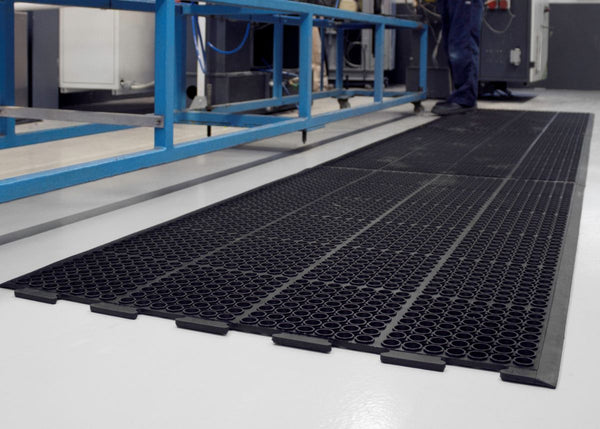
Heavy Duty Interlocking Workshop Mats
- Interlocking format: scalable coverage for wide bays and repeatable layouts
- Nitrile rubber construction: resistant to the majority of aviation fluids including Jet-A1, grease, and oils (avoids swelling/curling that creates trip edges)
- Drainage holes: fluids pass through so the standing surface stays more stable underfoot
Zone 2: Component maintenance & machine shops (oily + impact risk)

The hazard: technicians standing at benches cleaning parts and handling tools in an oily environment. The risk isn’t only slips, as dropping a precision tool or component can be expensive and can trigger rework, inspection delays, or damage write-offs.
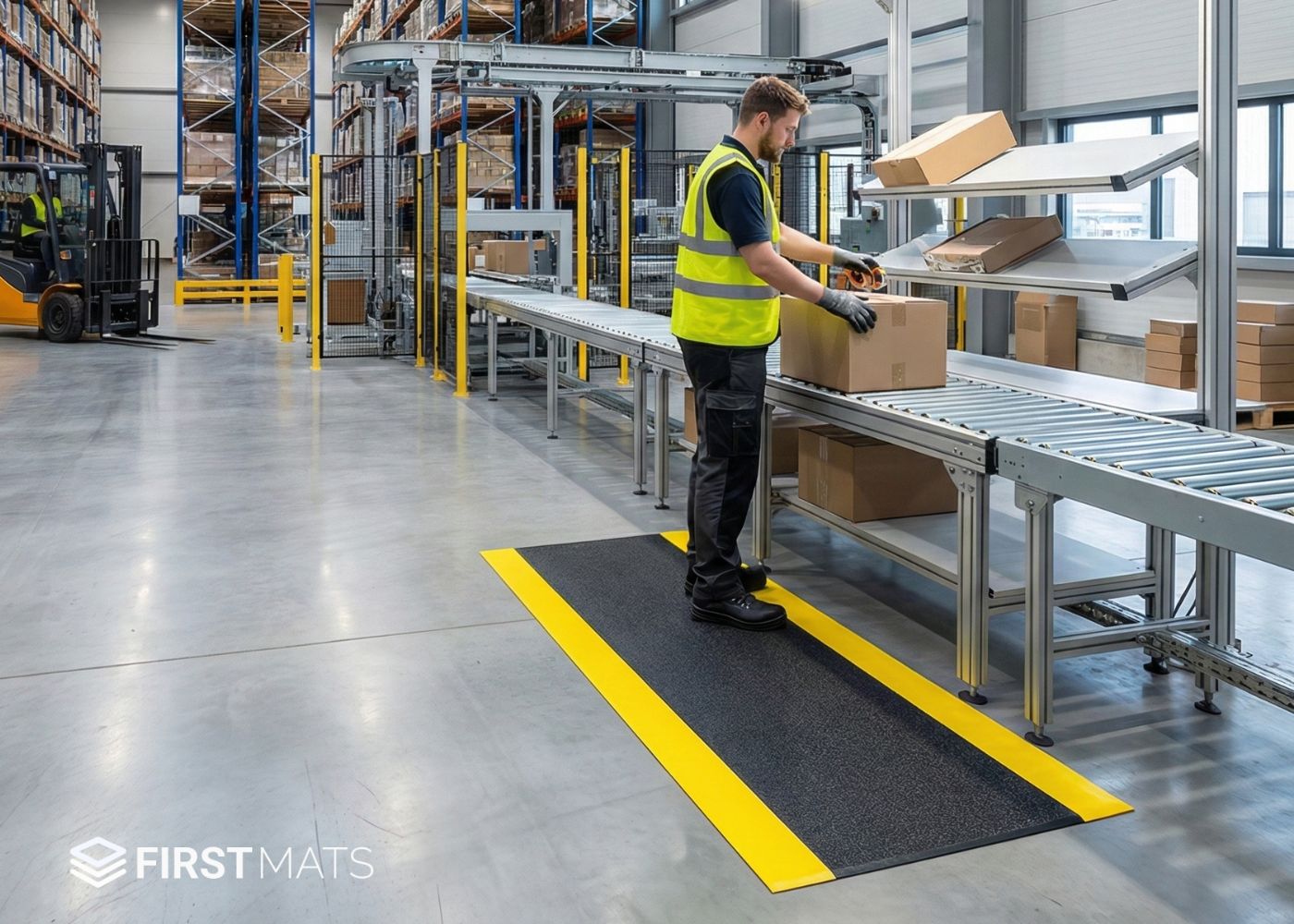
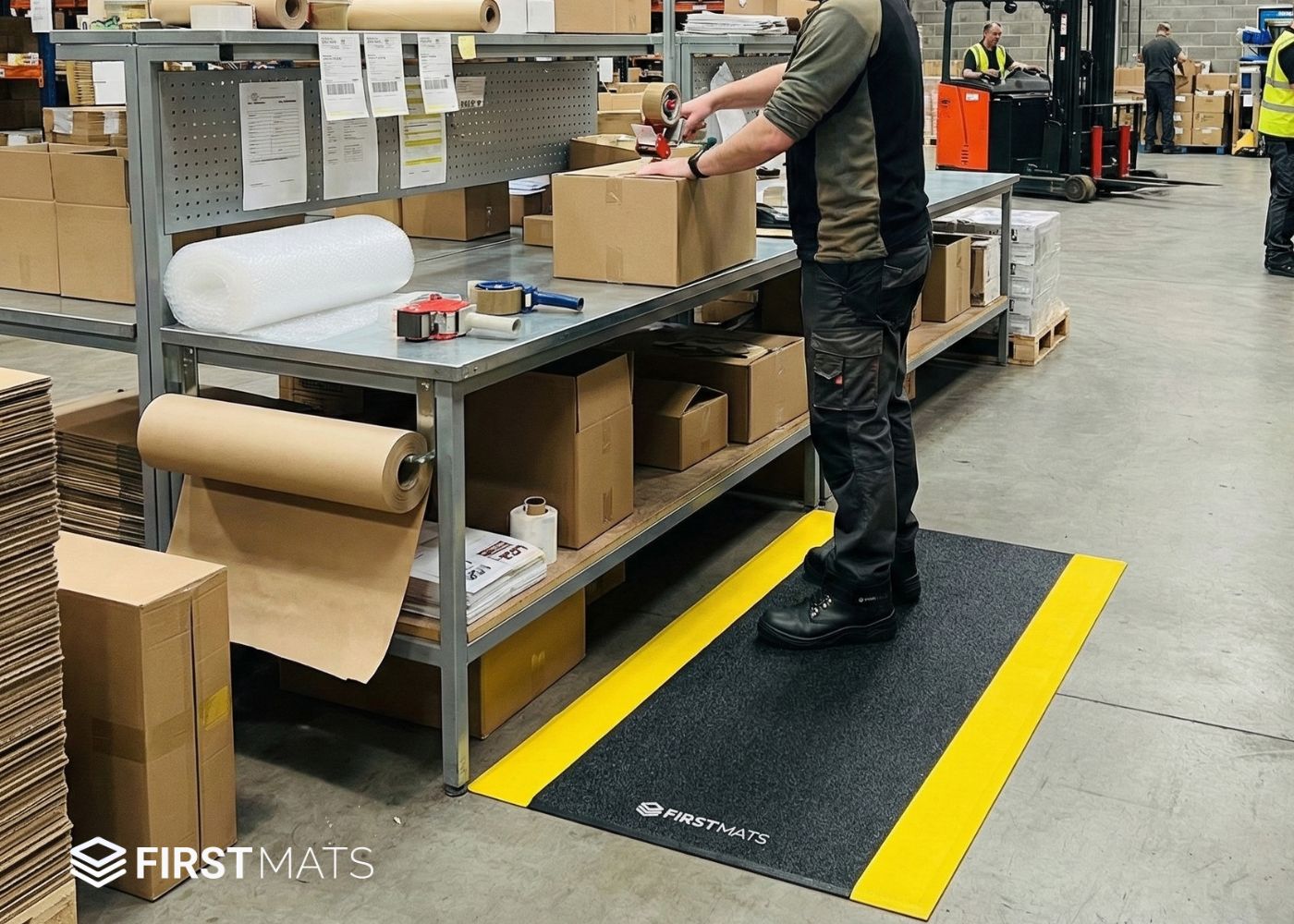
The matting approach: encapsulated comfort + high visibility. You want true anti-fatigue support that does not absorb oil like a sponge, and you want edges that are visually obvious in a busy hangar.
- Encapsulated design: foam core sealed inside nitrile rubber to reduce oil ingress and premature failure
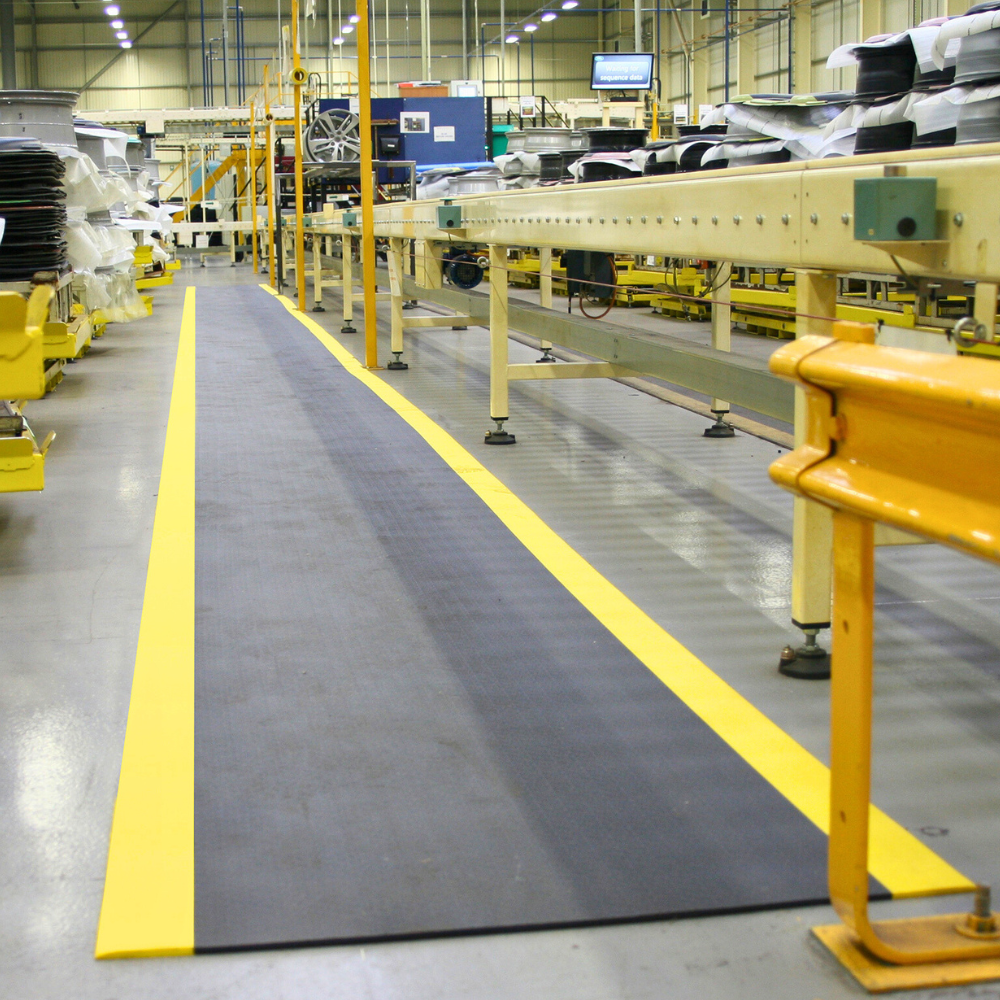
- Yellow safety border: clearer edge definition for busy work areas
- Tool protection benefit: shock absorption helps protect dropped tools from impact damage
Zone 3: Hot works & welding (fire risk + swarf)

The hazard: welding, grinding, cutting, and fabrication introduce sparks and hot particles. In an environment where fuels and flammables may be present, controlling ignition and fire spread matters. Hangar operators also have duties under the Regulatory Reform (Fire Safety) Order 2005 to manage fire risks in the workplace.
The matting approach: fire-tested flooring + hard-wearing surface that resists swarf embedding. For hot work zones, a mat with an appropriate fire performance classification is a practical control measure that supports risk assessments.
The Ultimate Industrial Anti-Fatigue Mat is built for the toughest working environments, offering reliable comfort where others fall short. Its fully sealed surface resists water, oil, swarf, and chemical spills,… From £35.69 + VAT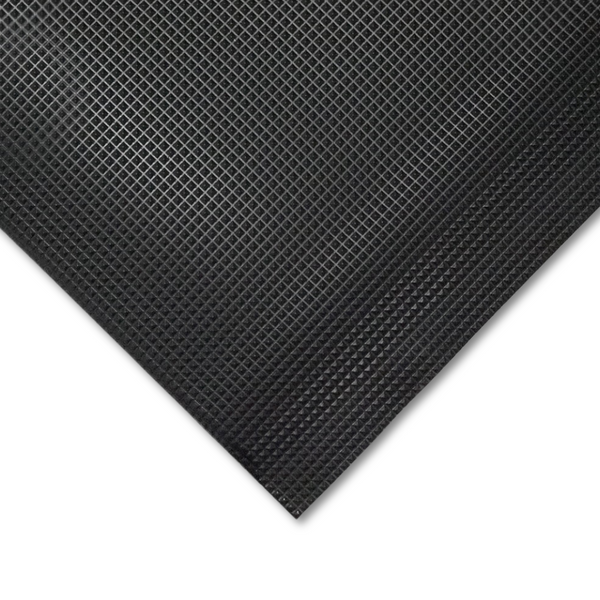
Ultimate Industrial Anti-Fatigue Mat
- Fire resistance focus: specified as BS EN 13501-1 rated for fire performance (key for hot work areas)
- Custom lengths: practical for long benches, fabrication lines, and repeat workstations
- PolyNit surface: tough outer layer designed to resist wear and reduce swarf embedding
Zone 4: Avionics labs & clean rooms (ESD control)

The hazard: Electrostatic Discharge (ESD) can damage sensitive electronics, such as flight computers, avionics modules, UAV components, sometimes without visible signs until failure later. In these environments, matting should support static dissipation without introducing particles, odours, or shedding.
What safety officers look for: ESD control referenced against BS EN 61340-5-1 (the IEC standard is typically paid-access; HSE provides general guidance on static and electricity here: HSE electricity FAQ (static/electrical safety)).
The matting approach: clean polyurethane + ergonomic support for fine bench work.
PremBubble ESD Mat: Ultimate Anti-Fatigue Comfort Enhanced Comfort and Safety: The PremBubble ESD Anti-Fatigue Floor Mat is engineered to provide a comfortable standing surface, reducing fatigue in environments where prolonged… From £120.55 + VAT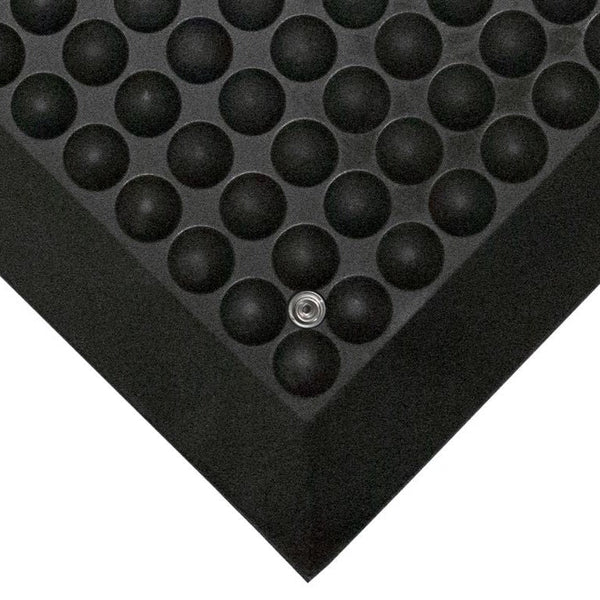
PremBubble ESD Anti-Fatigue Floor Mat
- Polyurethane (PU): “clean” material choice (lower shedding, suitable for controlled environments)
- ESD control intent: supports static dissipation requirements aligned to BS EN 61340-5-1
- Ergonomics: bubble profile supports circulation for technicians doing detailed soldering/inspection work
Specifying correctly: the “hangar matting” short checklist
- FOD control: Will the mat shed, crumble, or fragment over time? (Avoid anything that creates debris.)
- Fluid resistance: Is the material resistant to the majority of aviation fluids (including Jet-A1 and oils)? (Avoid claiming universal resistance to specialist hydraulic fluids.)
- Slip management: Does the mat drain or retain liquids? Choose drainage for wet zones and stable surfaces for walk routes.
- Fire performance: In hot work areas, specify mats with appropriate fire testing (e.g., BS EN 13501-1 rated products).
- ESD control: In avionics areas, specify antistatic/dissipative solutions aligned to BS EN 61340-5-1.
- Visibility & edges: Where people and equipment move fast, high-visibility borders and safe edges reduce incidents.
A hangar matting strategy is a ground-operations control: it reduces injury risk, protects components and tools, and supports compliance expectations, without adding new hazards to the workspace.