


Buying Guides
How Floor Mats Support Workplace Health and Safety
Floor mats can support a safer, cleaner workplace, but only when they are matched to the environment and kept in good condition. In practice, that means looking at the actual floor-level risk first: rainwater at entrances, dirt transfer through shared routes, contamination in industrial areas, or discomfort from prolonged standing. This guide explains where matting may help, where it is not enough on its own, and what to check so a mat does not become a trip hazard or a maintenance problem. It treats matting as one part of wider risk control alongside cleaning, drainage, housekeeping, floor surfaces and task design.

Floor mats are often treated as a quick fix for wet floors, tracked-in dirt and tired legs. In reality, they are more useful when approached as part of a wider floor safety plan. The right mat in the right place may help manage moisture, contamination and standing discomfort, but a poor choice can do very little or even introduce a new hazard.
That matters because floor-level risks remain significant. The latest HSE key figures show 680,000 working people sustained an injury at work in Great Britain, while 40.1 million working days were lost due to work-related illness and workplace injury. HSE also states in its guidance on slips and trips that slips and trips account for around 40% of all reported major injuries.
For facilities managers and safety leads, the practical question is not whether mats are good or bad. It is whether a specific mat suits a specific risk pattern, and whether the site can keep it clean, flat and effective.
Start with the hazard, not the mat
A good matting decision begins with the floor condition you are trying to manage. Common workplace patterns include rainwater being walked indoors, dirt transfer from outside routes, oil or process contamination in industrial areas, or prolonged standing at fixed workstations.
That approach helps avoid a common mistake: choosing a mat by category name alone. An anti-fatigue mat may be useful for standing comfort but unsuitable where trolleys pass over it. An entrance mat may cope well just inside a doorway but perform poorly in a fully exposed outdoor position. A walkway mat may help define a route, but it still needs to sit flat and suit the traffic using it.
HSE guidance is also clear on the wider principle: floors should be suitable for the work activity and kept free, so far as reasonably practicable, from obstructions or substances that could cause slips or trips. Matting can support that goal, but it does not replace cleaning, maintenance, drainage, suitable flooring or sensible housekeeping.
Entrances: moisture and dirt control matter most
Entrances are one of the clearest use cases for matting because they are where water and contamination first enter the building. In wet weather, a mat can help reduce the amount of moisture and dirt carried onto internal floor finishes, especially in receptions, lobbies, shared corridors and access points between indoor and outdoor areas.
The key point is coverage. HSE's store entrance case example shows that matting which is too small may fail to cope with tracked-in rainwater, leaving nearby floor areas slippery. That is a useful reminder that simply placing any mat near a door is not the same as controlling the risk.

What to look for at entrances
- Enough matting in the main walking line, not just a token piece by the threshold
- A surface suited to capturing moisture, dirt or both, depending on the location
- Edges that stay flat and do not lift under traffic
- A cleaning routine that removes retained water and debris before the mat becomes saturated or overloaded
For internal entrance zones where moisture capture is the main issue, a dedicated entrance mat may be the most relevant type.
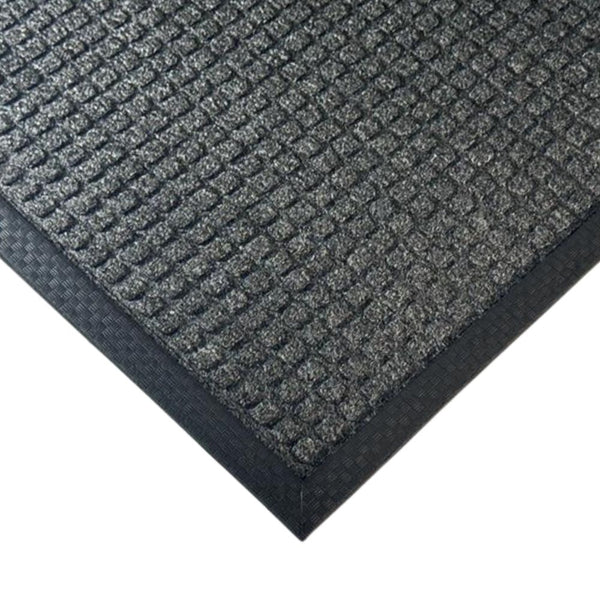
AquaProtect Super Absorbent Door Mat
The AquaProtect Super Absorbent Door Mat is made for entrances that have to deal with wet weather, muddy shoes, and heavy daily footfall. Holding up to 6 litres of water…
- Super Absorbent: Holds up to 6 litres of water per square metre.
- Highly Durable: 10.5mm thickness with Decalon fibres for long-lasting use.
- Non-Slip Design: Rubber backing prevents movement on smooth floors.
- Wheelchair Accessible: Reinforced border for added stability.
From £30.60 + VAT
Outdoor thresholds can need a different approach. In a more exposed position, the priority may be scraping off heavier dirt before it reaches the internal floor, rather than expecting one indoor mat to handle everything.
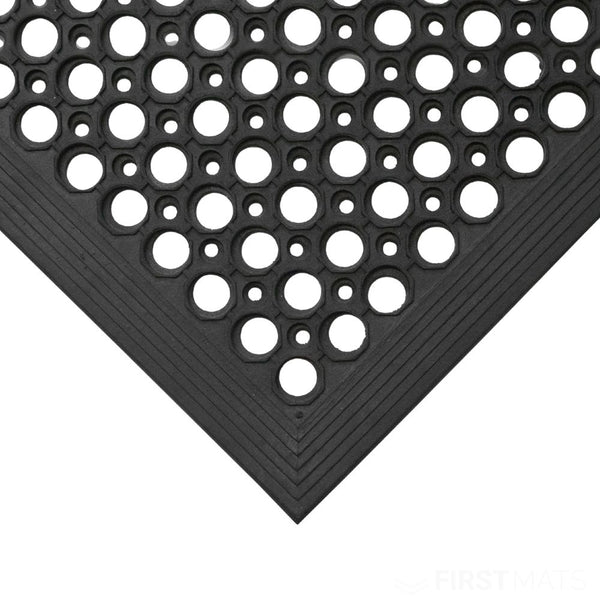
EntraGuard Rubber Door Mat with Holes
The EntraGuard Rubber Door Mat with Holes is built for tough outdoor use, combining durability with smart design. Its open hole pattern scrapes dirt and stones from shoes while allowing…
- Durable Natural Rubber: Long-lasting and wear-resistant material.
- Improved Drainage: Hole pattern removes water and debris efficiently.
- Slip Resistant: Meets EN 13552 Cat R10 standards for safety.
- Temperature Resistant: Performs in extreme conditions from -20°C to +130°C.
From £19.45 + VAT
Between outdoor and indoor stages, it is often better to think in layers: scrape outside, absorb inside, then keep inspecting both areas during poor weather. That is usually more realistic than expecting one mat to solve all entrance conditions on its own.
Industrial areas: suitability is more important than labels
In workshops, production spaces, stores and service corridors, the hazard picture is usually more varied. You may have dust, swarf, packaging debris, light moisture, frequent foot traffic, wheeled equipment or repeated turning movements in the same area. In these spaces, a mat needs to suit both the contaminant and the traffic.
That is why generic safety language can be misleading. A mat that feels grippy underfoot may still be the wrong choice if it shifts, curls, traps debris in a busy route or interferes with wheeled movement. Likewise, a softer cushioned surface may help at a fixed standing station but be unsuitable in a route used by pallet trucks or trolleys.

Practical checks for industrial spaces
- Whether the area is mainly a standing workstation or a travel route
- Whether contamination is dry, wet or mixed
- Whether wheeled traffic needs a firmer, more stable surface
- Whether the mat can be cleaned without creating too much downtime
For longer internal routes or defined pedestrian areas, walkway matting can be useful where you need a practical, durable running surface that helps manage dirt and wear across a broader zone.
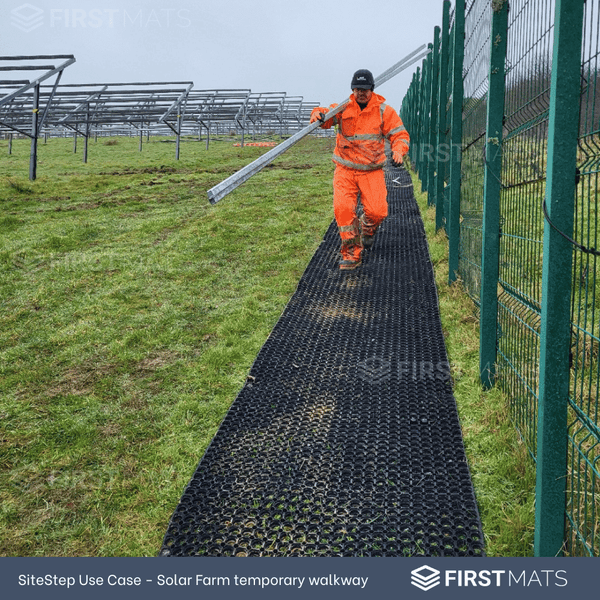
SiteStep Walkway Matting Roll
The SiteStep Walkway Matting Roll is the ultimate solution for creating clean, safe, and defined walkways across grass, gravel, and other uneven outdoor surfaces. Ideal for temporary footpaths at events,…
- Slip-Resistant Surface: Improves safety on grass, gravel, and uneven ground.
- Mud-Scraping Holes: Help remove dirt and debris from footwear.
- Durable Rubber: Built to endure heavy foot traffic and outdoor conditions.
- Portable Format: Supplied in a roll for easier transport and deployment.
From £24.50 + VAT
In fixed work positions, the goal may be different. HSE's guidance on lower limb disorders includes anti-fatigue matting as one possible control where prolonged standing is a risk. That wording matters: it is a possible ergonomic aid, not a cure-all.
Standing work: anti-fatigue mats may help increase productivity.
Where staff stand in one place for long periods, such as at packing benches, counters, workstations or inspection points, anti-fatigue matting may help reduce discomfort for some users.
The evidence base is supportive, and backed up by a review of research on flooring and standing comfort that suggests cushioning surfaces can help in many situations.

That said, anti-fatigue matting is best treated as one ergonomic measure within a wider review of standing work. Task rotation, workstation height, footwear, posture and break patterns still matter.
For fixed standing stations where cushioning is the main requirement, a standard anti-fatigue mat is the most relevant option.
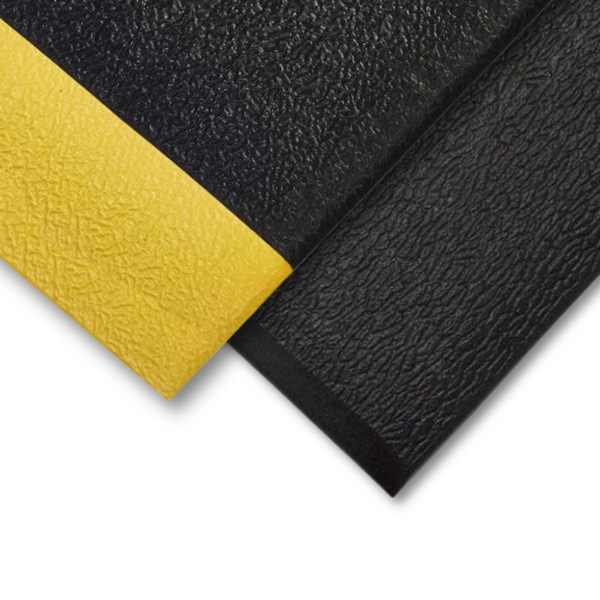
AtEase Standard Anti-Fatigue Mat
The AtEase Standard Anti-Fatigue Mat offers a simple, effective way to improve comfort in light-use work areas. Whether youre packing boxes or assembling small items, this mat provides welcome relief…
- Optimal Thickness: 9mm cushioning provides the perfect balance of comfort and support.
- Flexible Sizing Options: Choose from standard sizes or customize for the perfect fit.
- Safety First: High-visibility yellow safety border and beveled edges reduce trip risks.
- Versatile Use: Ideal for dry industrial and commercial spaces.
From £22.50 + VAT
If you want a real-world example of how this kind of matting is used, this case study may help the editorial team decide whether an applied example adds value here.
When using anti-fatigue mats, check that they do not create awkward edges, interfere with access or conflict with the movement of stools, trolleys or other equipment. Comfort is not the only criterion.
Outdoor areas and transition points
Outdoor areas create a slightly different challenge because the weather, surface contamination and exposure level are less controlled. A mat at an external doorway, site cabin entrance, yard access point or service entrance may help remove heavier dirt before it reaches internal flooring, but it also needs to tolerate the conditions it sits in.
Transition points deserve extra attention. A route from wet paving to a smooth internal floor is often where risk changes quickly. In these areas, matting can support the transition, but only if it is stable, suitably placed and backed by prompt cleaning of the surrounding floor.
It is also worth checking whether water is bypassing the mat entirely. If users regularly step around it, if deliveries force traffic off the main line, or if the mat is too small for the doorway width, performance in practice may be far worse than expected.
How mats create hazards when selection or upkeep is poor
Not every mat improves safety. Worn, curled, undersized or badly positioned mats can create trip points, shift underfoot or leave contamination on surrounding floors. That is one reason this should be treated as a maintenance and inspection issue, not just a purchasing decision.
Common failures to watch for
- Edges that curl, fray or no longer sit flat
- Mats that are too small for the traffic pattern
- Saturated mats left in place during wet weather
- Mats placed where doors, wheels or repeated turning movements disturb them
- Debris build-up that reduces the mat's practical value
A simple site check is often enough to spot problems early: does the mat stay flat, stay in place, cover the walking line, and remain reasonably clean between service intervals? If not, the answer may be a different mat, a different location, more frequent cleaning, or no mat at all in that exact spot.
For mat well installations or more integrated entrance systems, this case study may help provide context on where a fitted approach can be more suitable than loose-laid matting.
The broader lesson is simple: matting should be reviewed like any other floor control. If conditions change, the matting plan may need to change as well.
A practical way to assess workplace matting
If you are reviewing a site, work through each zone with the same questions:
- What is the main floor-level hazard here: water, dirt, contamination, prolonged standing, or a surface transition?
- Is matting genuinely useful in this exact location, or would cleaning, drainage or flooring changes have more impact?
- Does the mat type suit the traffic, including wheeled movement where relevant?
- Is the mat large enough and placed in the actual walking line?
- Can the site inspect, clean and replace it before wear becomes a risk?
That process keeps matting in the right role: a practical support measure within wider workplace health and safety, not a substitute for managing the floor properly.