


Advice
How to Lay Site Matting on Uneven Ground: Practical Guidance for Temporary Walkways
30% of employee non-fatal injuries reported under RIDDOR in 2024/25 were slips, trips or falls on the same level. On a construction site, that makes temporary walkways more than a housekeeping detail. This guide explains how to assess uneven ground before you order matting, how to choose between rolls and tile-style formats, and how to lay, check and maintain a temporary pedestrian route without assuming matting will fix poor ground on its own.

30% of employee non-fatal injuries reported under RIDDOR in 2024/25 were slips, trips or falls on the same level. On a construction site, temporary walkways need proper planning, not just a quick roll-out of matting.
HSE guidance on slips and trips in construction points to uneven surfaces, wet ground, obstacles and changes in level as common hazards. HSE guidance on temporary workplaces and unprepared routes also makes the wider point: surfaces should be firm, even and properly drained. So the first question is not which mat to buy. It is whether the ground is suitable for any temporary matting in the first place.
When site matting is appropriate
Site matting can help create a defined pedestrian route across imperfect ground for a temporary period. It can also help manage mud transfer, make a route more obvious, and give people a clearer path to follow between cabins, gates, compounds or work areas.
That said, matting is only one part of the route plan. Under CDM 2015 Regulation 27, traffic routes on construction sites must be suitable for the people or vehicles using them. In practice, that means the route still needs to be checked, maintained and kept usable as site conditions change.
Do not treat matting as a fix for deep rutting, voids, active ground movement, washout, standing water that keeps returning, or areas where the surface keeps breaking up underfoot. In those cases, ground improvement or a different access arrangement may be the better starting point.

Rubber, PVC and tile-style formats
For temporary pedestrian routes, rubber walkway rolls may suit longer straight runs where you need quick coverage and some flexibility over minor surface variation. PVC walkway rolls may be worth checking for cleaner, firmer hard surfaces where route visibility matters, but you should confirm the product is intended for construction-site pedestrian use before relying on it in muddy or unstable conditions. Larger ground protection tiles are usually a different category again, and may suit routes where the base is too rough or mixed for a lighter walkway mat to sit consistently.
SiteStep Walkway Matting Roll is one option to consider when you need a continuous pedestrian route across grass, gravel or uneven outdoor surfaces and want a roll format rather than separate panels.
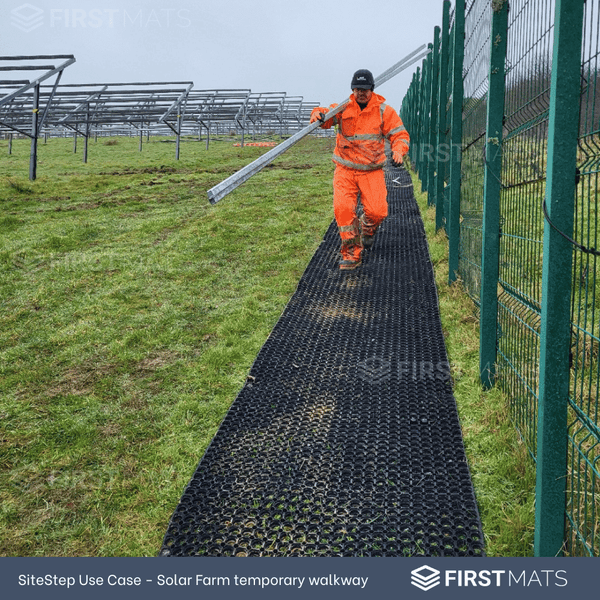
SiteStep Walkway Matting Roll
The SiteStep Walkway Matting Roll is the ultimate solution for creating clean, safe, and defined walkways across grass, gravel, and other uneven outdoor surfaces. Ideal for temporary footpaths at events,…
- Slip-Resistant Surface: Improves safety on grass, gravel, and uneven ground.
- Mud-Scraping Holes: Help remove dirt and debris from footwear.
- Durable Rubber: Built to endure heavy foot traffic and outdoor conditions.
- Portable Format: Supplied in a roll for easier transport and deployment.
From £24.50 + VAT
If the route includes rougher mixed ground or short sections that may need lifting and resetting as the job changes, Ground-Stabiliser Mud Mat Tiles may be easier to work with than one long roll.
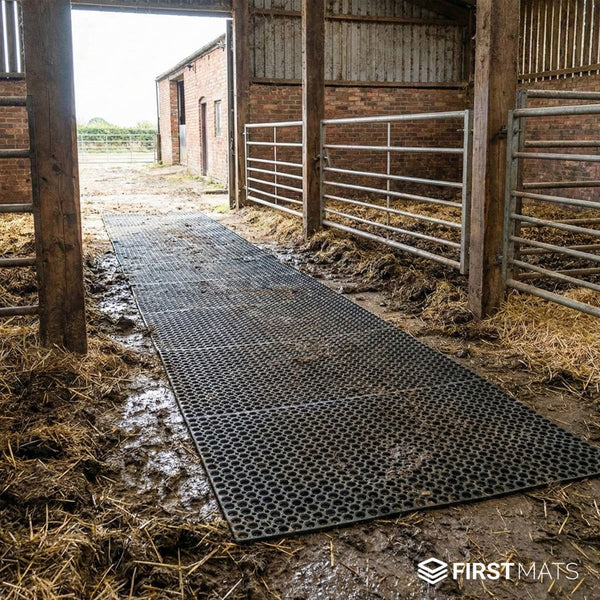
Ground-Stabiliser Mud Mat Tiles
Ground-Stabiliser Mud Mat Tiles are designed to turn muddy, uneven, or heavily worn areas into safer, more practical spaces for both people and animals. Whether used around gateways, stables, feeding…
- Stabilises Soft Ground: Can be partly submerged for permanent use.
- Durable Rubber: Designed to withstand the demands of farm areas.
- Slip-Resistant Surface: Reduces the risk of slips on site.
- Mud-Scraping Holes: Keeps walkways cleaner and safer.
From £24.50 + VAT
Assess the ground before you lay anything
Walk the full route first. Do not just inspect the start and finish points. The common failure points are usually midway along the path, where mud collects, gravel loosens, edges lose support or a hard surface changes level.
-
Mud: Check whether the mud is just surface contamination or whether the ground is soft underneath. If boots sink in and the base deforms as people walk, a loose-laid mat may move or settle unevenly.
-
Gravel or hardcore: Look for loose top layers, sharp high spots and hollows. Small surface variation may be manageable, but pronounced ridges or depressions can leave sections unsupported.
-
Concrete or hardstanding: Look for broken edges, patched repairs, sudden level changes and ponding. A firm base is useful, but only if it is still reasonably even along the route.
-
Mixed surfaces: Pay close attention where mud meets slab, slab meets gravel, or temporary ramps meet open ground. Transitions are often where edges lift or the route feels inconsistent underfoot.
Also look at drainage before you choose the mat. Poor drainage will keep reintroducing the same problem even after a tidy installation. If water runs across the route or collects under it, expect movement, contamination build-up and repeated maintenance.
For wider access planning on rough sites, this guide to demolition site ground protection and safety mats is useful background.
Know the limit of surface preparation
On a temporary job, preparation needs to be practical. Remove obvious debris, knock down isolated high spots where you can, and choose the straightest route that avoids the worst ground. But if the area has deep soft spots, active washout or unstable fill, basic preparation is not enough. That is the point to stop and review the route rather than cover the problem.
Choose the right format for the route
Format affects how easy the walkway is to lay, adjust and maintain.
When rolls make sense
Roll matting often suits longer, straighter pedestrian routes where you want fewer joins and quick deployment. It can be a practical choice between site entrances, welfare areas and cabins, especially if the ground condition is imperfect but broadly consistent.
The trade-off is that a roll can be harder to keep flat if the route has repeated dips, ridges or surface changes. One continuous length will often show any weakness in the substrate.
When tiles or smaller sections make sense
Tiles or shorter sections can be easier to place around awkward corners, patchy ground and localised trouble spots. They are also easier to lift for cleaning or to reposition if part of the route needs to move as the site changes.
The trade-off is more joins. On temporary walkways, joins and edges are usually the first places where issues appear, so each connection needs careful checking after installation and during use.
Heavy-Duty Ground Protection Tiles - 150 Tonne may be worth reviewing where the walkway crosses mixed ground and you need a more panel-based layout with compatible connector options.
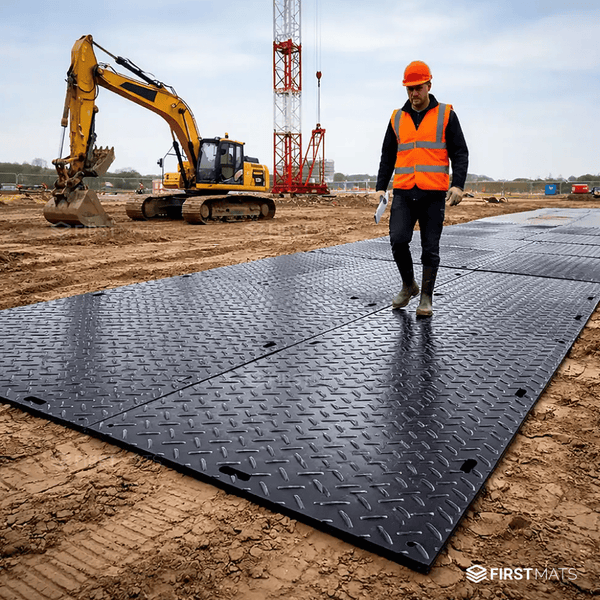
Heavy-Duty Ground Protection Tiles - 150 Tonne
Protect high-traffic surfaces with confidence using the Ground Protect Heavy-Duty Tile, a premium ground protection mat built for demanding environments. Supporting loads of up to 150 tonnes and tested to…
- Slip-Resistant Surface: Improves safety on grass, gravel and uneven ground.
- Heavy-Duty Load Capacity: Supports up to 60 tonnes for machinery and site vehicles.
- Dual-Sided Design: One side for pedestrians, one for vehicles with maximum traction.
- Easy to Handle: Integrated hand holes allow quick lifting and positioning.
From £11.39 + VAT
If the aim is a defined route on firmer hard surfaces where visibility is a key concern, SafePath High Visibilty Walkway Matting is another format to compare, but check its technical suitability for the exact site conditions before use on muddy or unstable ground.
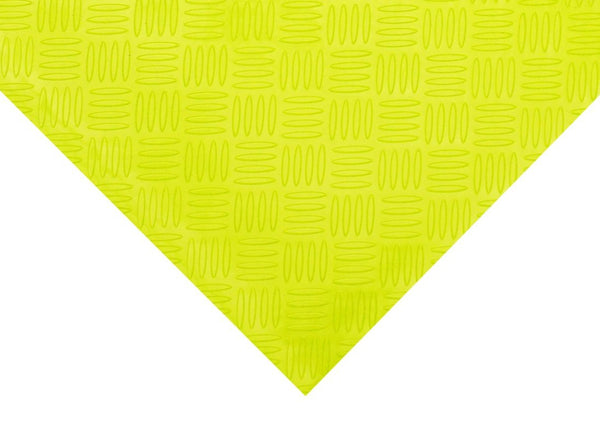
SafePath High Visibilty Walkway Matting
The SafePath High Visibility Walkway Matting is the ultimate safety solution for construction sites and industrial environments. Designed from durable PVC, this matting ensures long-lasting performance while clearly marking pedestrian…
- High-Visibility Design: Bright yellow colour clearly marks walkways for improved safety.
- Durable Material: Manufactured from heavy-duty PVC for long-lasting performance.
- Weatherproof and Chemical-Resistant: Reliable for both indoor and outdoor environments.
- Low-Profile Surface: 2mm thickness ensures a trip-free design.
From £64.76 + VAT
How to lay the matting in a practical way
Once you have confirmed the route is stable enough for temporary matting, keep the installation simple and repeatable.
-
Mark the route first. Confirm the start point, finish point, width and any changes in direction before unrolling or placing anything.
-
Clear loose debris. Remove rubble, sharp protrusions, large stones and waste that could stop the mat sitting properly.
-
Test a short section. Lay a small length or a few panels first and walk the route. Look for rocking, unsupported edges, bridging over hollows or movement at transitions.
-
Lay from the most stable point. Start on the firmest section of the route and work outward. This helps you spot where the substrate begins to cause problems.
-
Keep joins tight and deliberate. Follow the product-specific guidance where connectors are supplied. Do not guess a universal joining method.
-
Check edges as you go. If an edge sits proud because of a rut, stone ridge or slab change, deal with the substrate or alter the route. Do not assume foot traffic will flatten it.
-
Review after first use. Once people have walked the route and the surface has settled, inspect the whole run again.
Anchoring needs extra caution. Some products in the supplied range include pegs or connectors, but that does not mean the same method suits every surface or every site. Ground type, buried services, damage risk and product guidance all matter. Use the manufacturer’s instructions and your site assessment rather than a one-size-fits-all fixing method.
Measure with the route in mind
Measure the actual walking line, not a neat plan view that ignores bends, pinch points or door approaches. Also decide where people will step on and off the matting. A well-laid middle section can still fail in practice if the entry and exit points are messy, muddy or uneven.
SiteGuard Mud Control Mat can be useful at transition points such as cabin doors, welfare entrances or site access points where the main problem is concentrated mud and debris rather than a full route across open ground.
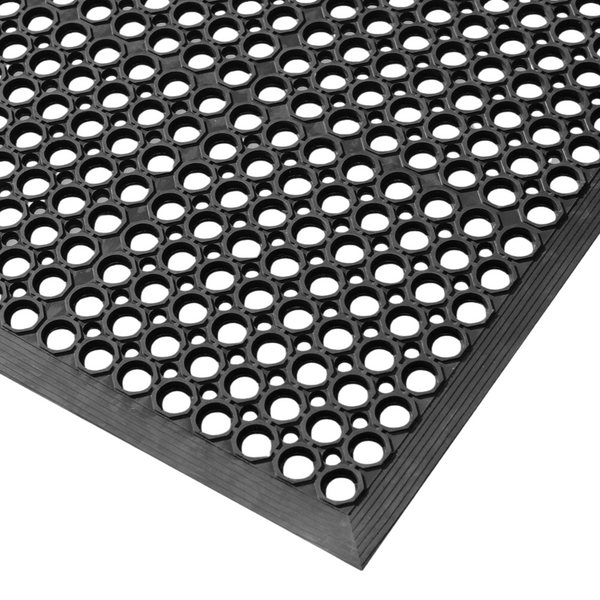
SiteGuard Mud Control Mat
The SiteGuard Mud Control Mat is the ultimate solution for maintaining clean and safe construction sites. Engineered with high-grade natural rubber, this trade-rated mat offers exceptional durability and can withstand…
- Durable Material: Made from high-grade natural rubber for longevity.
- Optimised Design: Holes scrape mud and drain water effectively.
- Slip-Resistant: Conforms to EN 13552 Cat R10 for enhanced grip.
- Wear Resistance: Rated 5/5 for tough environments.
From £19.45 + VAT
Drainage, cleaning and routine checks
Construction routes change quickly. Weather, nearby plant activity and repeated foot traffic can all affect how a temporary walkway performs. This is why route checks matter as much as the first installation.
Focus your checks on:
-
edge lift or curled corners
-
movement at joins
-
mud or debris packed into the surface
-
water collecting on or under the mat
-
new holes, ruts or soft spots beside the walkway
Clean the route in a way that suits the product guidance and the site conditions. On many temporary installations, the practical aim is simply to remove built-up mud, debris and trapped material before it affects footing or stops drainage. If a section has shifted, lift and reset it rather than trying to work around it.
At the end of the job, lift the matting carefully, clear off contamination, let it dry if needed, and store it in a way that avoids unnecessary distortion or damage. Keep connectors or accessories with the main matting so the next installation is easier to manage.
When to stop and ask for site-specific advice
Ask for site-specific advice if the route crosses active construction traffic areas, unstable fill, fresh concrete, steep changes in level, persistent standing water or ground that continues to deform after basic preparation. The same applies if you need the matting to do more than temporary pedestrian access.
The safest buying decision is often the one that rules matting out for a particular area until the ground or route design improves. If you are unsure, get product-specific guidance before ordering or laying the route.