Buying Guides
Demolition Site Ground Protection & Safety Mats

Why ground-level controls are a critical safety system, not an afterthought
Ground conditions are one of the most underestimated risk factors on demolition sites. From heavy plant movements to dust migration and pedestrian access, what happens at ground level directly affects safety, compliance, and productivity across the entire project.
At First Mats, we work closely with contractors, site managers, and safety professionals who are dealing with these risks every day. One pattern we see repeatedly is that ground protection, dust control, and walkway matting are often treated as secondary controls, added late, substituted with unsuitable materials, or misunderstood in terms of their technical purpose.
This article explains how ground protection and safety matting should be used correctly on demolition sites, with reference to current HSE guidance and UK legislation. We look at three critical areas; heavy plant access, dust migration, and pedestrian safety, and clarify where different matting systems are appropriate, where they are not, and the risks created when the wrong solution is used.

Heavy Plant & Temporary Access: Preventing ground failure and bogging
(The Active Demolition Zone)
The problem: Demolition routinely involves heavy plant (e.g., 30–50 tonne excavators, crushers, dumpers) operating over compromised ground: stripped foundations, infilled basements, made ground, or saturated clay. The result is predictable. Rutting, sinkage, instability, and increased risk to buried services.

The solution: Use specially designed ground protection mats, such as the First Mats Ground Protection Tiles, to create trackways for plant and equipment. This supports compliant traffic management by providing safe, predictable surfaces for vehicles in line with CDM traffic route duties (HSE L153 (CDM 2015)).
Key technical point: load distribution (not just traction). These mats are not “for grip” alone. Their primary job is load distribution, spreading point loads from tracks, outriggers, and tyre contact patches over a wider area to reduce ground pressure. This helps prevent:
- Plant sinking or “bogging” in soft ground
- Differential settlement that destabilises the machine during slewing/tracking
- Damage to buried services from crushing loads
Visual demarcation matters. Site walkway mats can also act as a visual control measure, signalling safe operating zones for plant. On well-managed sites, if a machine is off the mat, work stops until the route/pad is reinstated.
Don’t use plywood as a substitute on vehicle routes. At First Mats, we often see that clients have tried using Plywood in the past, but it is not suitable for repeated heavy loads: it can snap/delaminate, becomes dangerously slippery when wet. Plywood also degrades quickly in ground contact.
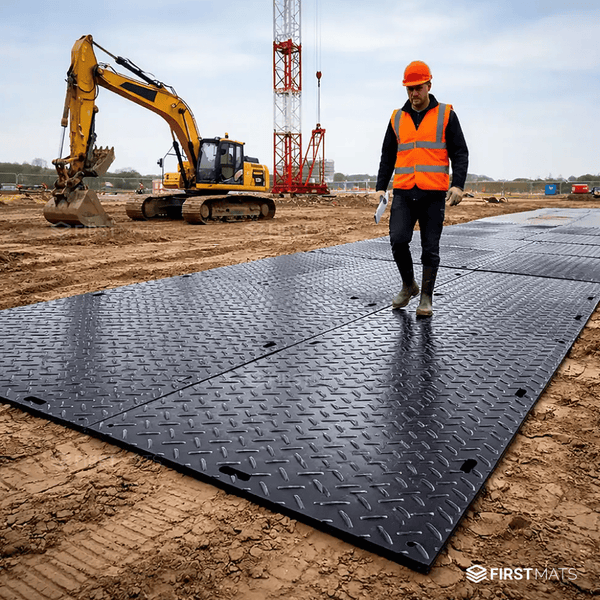
Heavy-Duty Ground Protection Tiles - 150 Tonne
Protect high-traffic surfaces with confidence using the Ground Protect Heavy-Duty Tile, a premium ground protection mat built for demanding environments. Supporting loads of up to 150 tonnes and tested to…
- Slip-Resistant Surface: Improves safety on grass, gravel and uneven ground.
- Heavy-Duty Load Capacity: Supports up to 60 tonnes for machinery and site vehicles.
- Dual-Sided Design: One side for pedestrians, one for vehicles with maximum traction.
- Easy to Handle: Integrated hand holes allow quick lifting and positioning.
From £11.39 + VAT
Dust Migration: Controlling the “Invisible Hazard”
(The Transition & Decontamination Zone)
The problem: Demolition generates fine particulate hazards that travel easily: respirable crystalline silica (RCS), asbestos fibres (where present), and general dust/debris. These contaminants migrate into welfare units, offices, vehicles, and sometimes off-site, creating health risk and compliance exposure under COSHH.
The regulatory baseline: HSE identifies construction dust as a major, preventable health risk. See HSE CIS36 (Construction dust) and HSE: Silica dust in construction. COSHH (Control of Substances Hazardous to Health Regulations) requires exposure to hazardous substances to be prevented or adequately controlled. (For the legislation text, see COSHH Regulations 2002.)
The solution: use contamination control mats (sticky/tacky peel-off mats) at clean-zone entry points as part of a layered dust control strategy aligned with HSE guidance.

Key technical point: the peel-off mechanism. Sticky mats use multiple adhesive layers. When the top layer is contaminated, you peel it away to expose a clean sheet, restoring performance quickly without replacing the whole unit.
Placement rule (non-negotiable): The exprts at First Mats say that Tacky Mats must be installed after boot wash/scraper stations. They do not work on wet mud, only on fine dust/silica. If mud is present, the adhesive surface is blocked and becomes ineffective.
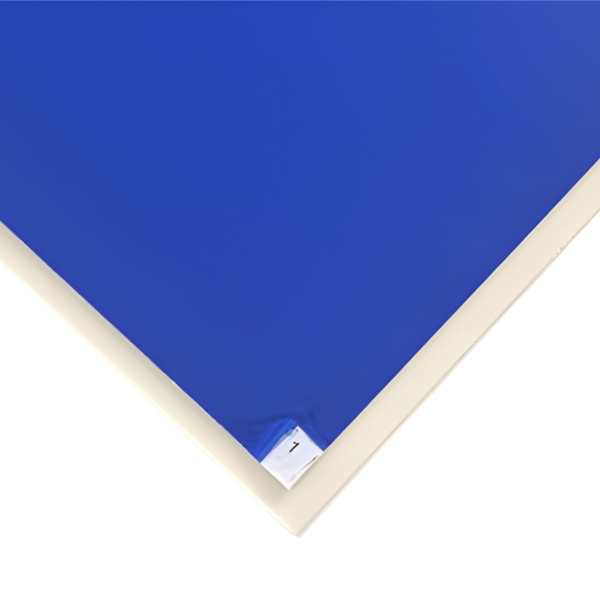
Standard Disposable Tacky Dust Mats - 60cm x 76cm
Enhance cleanliness and hygiene with our standard-size Disposable Tacky Dust Mats, expertly designed to capture dust, germs, and fine particles. Ideal for sterile environments like hospitals and clean rooms, these…
- Hygienic Design: Antimicrobial additive inhibits bacteria and mould.
- Effective Dust Capture: Tacky surface traps dust, dirt, and fine particles.
- Peelable Layers: 30 numbered layers for simple maintenance.
- Durable Frame: Made of rigid polystyrene with non-slip backing.
From £42.90 + VAT
Pedestrian Safety: Managing slip risks in welfare and transition zones
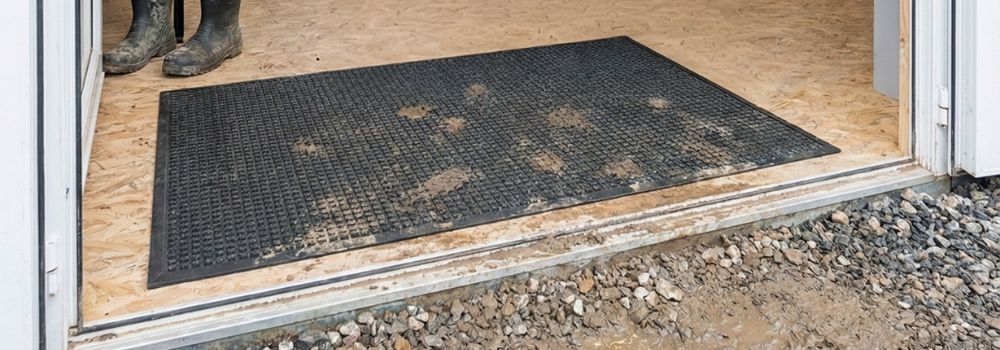
The problem: Wet mud and water tracked into drying rooms, canteens and site offices creates predictable slip risk, especially at entrances and corridor transitions. HSE guidance on slips and trips highlights contamination (e.g., wet/mud) as a primary contributor and supports using entrance matting to reduce the hazard (HSE INDG225: Preventing slips and trips at work).
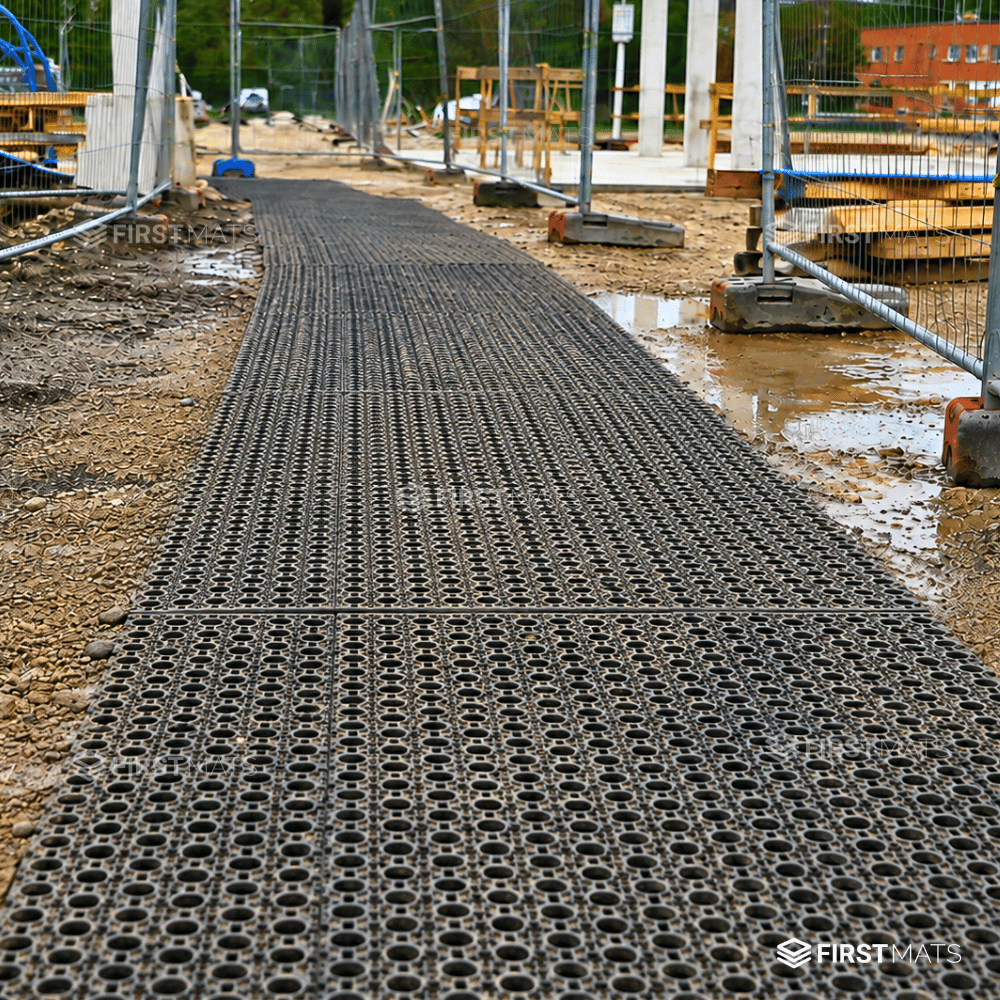
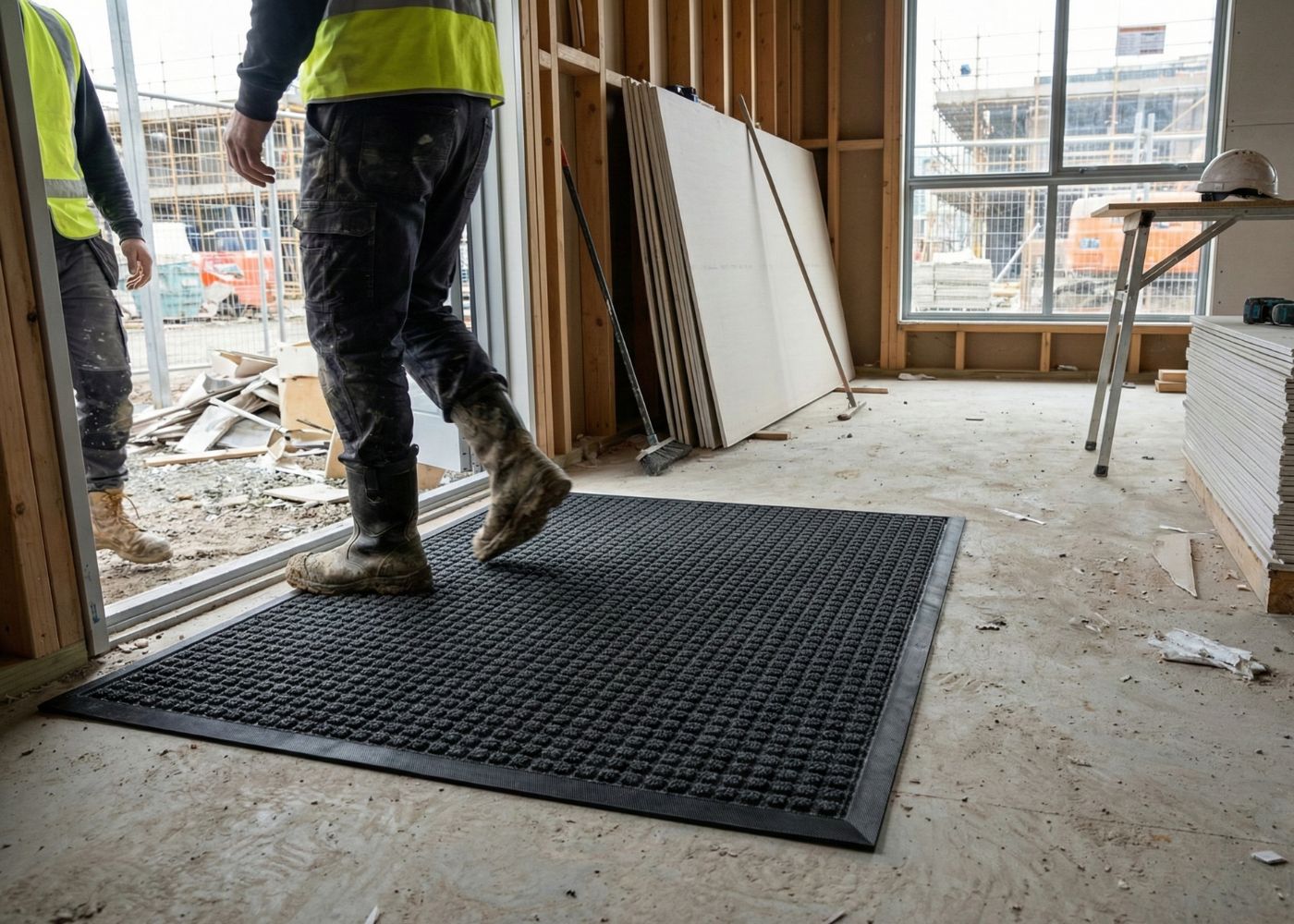
The solution: use robust scraper mats and site walkway matting designed for wet, external environments.

Key technical point: permeability. Demolition sites are wet. Standard textile/carpet mats quickly become saturated, heavy, and unstable. Permeable matting allows water to drain through, maintaining traction and reducing standing water at entrances.
Don’t do this: don’t use indoor carpet mats outdoors. They become sodden, curl at the edges, and frequently turn into trip hazards, exactly the scenario HSE slip guidance aims to prevent.
HSO Quick Check: Daily Matting Inspection Log
The team of experts at First Mats have created a simple checklist that you can use for your Daily Matting Inspection log.
Daily Matting Inspection Log
Zone 1: Active Demolition (Heavy Plant)
- [ ] Ground Stability: Are ground protection mats clearly visible and free from deep submersion in mud?
- [ ] Connection Integrity: If using trackway, are joiners/bolts secure? Loose mats can slide under excavator tracks and contribute to tipping risk.
- [ ] No Plywood: Verify no standard plywood is being used as a substitute on vehicle routes.
- [ ] Demarcation: Are mats defining the safe operating zone? If a machine is off the mat, stop and reinstate the route/pad.
Zone 2: Transition & Decontamination
- [ ] Sticky Mat Saturation: If the top sheet is grey/full, has it been peeled to reveal a fresh layer?
- [ ] Boot Wash Sequence: Is the sticky mat located after the boot wash/scraper station? (Wet mud renders sticky mats ineffective.)
- [ ] Edge Hazards: Are corners/edges flat, framed, or taped down to prevent trips?
Zone 3: Welfare & Walkways
- [ ] Drainage Check: Are external walkway mats draining effectively? If water is pooling on top, the mat is the wrong type (likely non-permeable) and must be replaced.
- [ ] Curl Check: Inspect edges of runner mats. If edges are curling (common with cheap carpet-style mats), they are a trip hazard, replace immediately.
- [ ] Cable Crossings: If temporary cables run across walkways, are they covered with appropriate cable protectors or distinct high-visibility matting?
Reference links (HSE & legislation)
- HSE L153: Managing health and safety in construction (CDM 2015) (see Regulation 27 – Traffic routes)
- HSE CIS36: Construction dust
- HSE: Silica dust in construction
- HSE INDG225: Preventing slips and trips at work
- The Construction (Design and Management) Regulations 2015 (legislation)
- COSHH Regulations 2002 (legislation)