


Buying Guides
What Is Insertion Rubber and When Should You Use It?

Choosing the wrong rubber sheet often shows up after fitting, not before: the material stretches too much, pulls around fixings, or behaves differently once it is clamped or cut. That is where insertion rubber comes into the conversation.
Insertion rubber is generally a rubber sheet reinforced with an internal fabric layer. You may also see it called reinforced rubber or fabric-inserted rubber. The point of that extra layer is not that it makes every sheet better in every way. It is there to change how the sheet behaves, usually by helping with stability and more controlled stretch under load.
If you are still comparing basic sheet types, this guide on rubber sheet types and applications is a useful starting point. This article focuses on when reinforcement is worth it and when plain sheet may be enough.
What insertion rubber is
Insertion rubber is a composite material. In simple terms, it is rubber with one or more internal fabric layers built into the sheet. That fabric reinforcement can change the sheet's mechanical behaviour, especially where the material is being pulled, clamped, handled repeatedly or asked to hold its shape more consistently.
That matters for buyers choosing sheet for cut gaskets, strip seals, protective pads, simple liners or bench coverings. In those jobs, the question is often not just "will this seal?" or "will this cover the surface?" but also "will it stay stable enough once fitted?"
You should not assume every insertion rubber grade uses the same fabric, the same number of plies or the same rubber compound. Construction varies, and that is why two reinforced sheets can perform quite differently.

How it differs from plain rubber sheet
Plain rubber sheet is just the rubber compound without that fabric insert. In many jobs, that is perfectly suitable. It is often the better choice when you want more flexibility, easier conformance to uneven surfaces, or a simpler low-cost material for general pads, coverings and cut parts.
Insertion rubber tends to be chosen when reduced stretch and better dimensional control matter more. That can help where the sheet will be bolted down, compressed between flanges, cut into narrower strips, or handled in a way that could otherwise distort the material.
The trade-off is that reinforcement can also make the sheet less easy to flex around tight shapes. It may not conform as easily as plain sheet in some sealing jobs. Reinforcement can also make behaviour direction-dependent, so the way the sheet performs may vary with the orientation of the fabric layer. That is worth checking if you are cutting parts that will be loaded in a particular direction.
When plain rubber sheet may be enough
Use plain rubber sheet when the job does not really need controlled stretch. Typical examples include general workshop pads, simple protective layers, bench protection, or straightforward gaskets where the material is mainly being compressed rather than pulled or stressed around fasteners.
The General Purpose Natural Rubber Sheet Roll is a practical example of that kind of material for broad workshop and maintenance use.
General Purpose Natural Rubber Sheet Roll (SBR) 1.5mm to 25mm
First Mats recommendationThe General Purpose Natural Rubber Sheet is a durable SBR rubber sheeting material designed for seals, gaskets, linings, protective coverings and other commercial or industrial applications. Its smooth surface and…
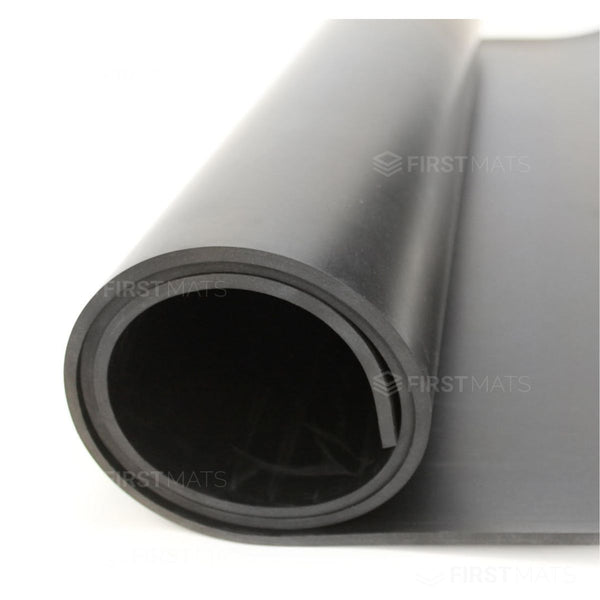
- Durable SBR Material: Provides long-lasting performance for demanding applications.
- Temperature Resistance: Operates efficiently from -30°C to +80°C.
- Custom Sizes: Available in thicknesses from 1.5mm to 25mm and lengths up to 10 metres.
- High Tensile Strength: 3.0 MPa tensile strength ensures wear resistance.
From £26.18 + VAT
If the application is more about environmental resistance than reinforcement, your material choice may need to start with the base rubber instead. Outdoor exposure, weathering, oils or chemical contact can matter more than whether the sheet has a fabric insert.
What tensile strength and elongation at break tell you
When comparing rubber sheets, tensile strength and elongation at break are common datasheet values to check. Tensile strength tells you how much pulling force the material can withstand before it breaks in a tensile test. Elongation at break tells you how much it can stretch before failure.
These numbers are useful comparison points, but they are not a shortcut to suitability. Test conditions, formulation, thickness and construction all affect the result. So use them to compare grades carefully, not to make sweeping assumptions.
The figures in the First Mats range are a good example of why reinforcement does not simply mean "stronger in every way". The Reinforced Insertion Rubber Sheet Roll has a tensile strength of 3.4 MPa and elongation at break of 190%. The General Purpose Natural Rubber Sheet Roll has a tensile strength of 3.0 MPa and elongation at break of 200%.
That small shift fits the usual buying logic for insertion rubber: slightly more resistance to pulling force, but a little less stretch. In practice, that can support better control rather than maximum extensibility.
The base polymer can matter just as much, or more. In the same range, EPDM Rubber Sheet Rolls are listed at 5.0 MPa tensile strength and 300% elongation, while the Neoprene Rubber Sheet Roll is listed at 6.0 MPa and 250% elongation. So if your real issue is weathering, oil contact or a need for a different rubber grade, changing polymer may be more useful than adding reinforcement to a general-purpose sheet.
The Reinforced Insertion Rubber Sheet Roll is the obvious option when the main requirement is a reinforced SBR sheet for more controlled behaviour under load or clamping.
Reinforced Insertion Rubber Sheet Roll (SBR) 1.8mm to 12mm
First Mats recommendationReinforced SBR Rubber Sheet: High-Strength, Customisable Sizes High Compression Load Applications: The Reinforced Insertion Rubber Sheet Roll is designed for high compression load applications, making it a reliable and robust…
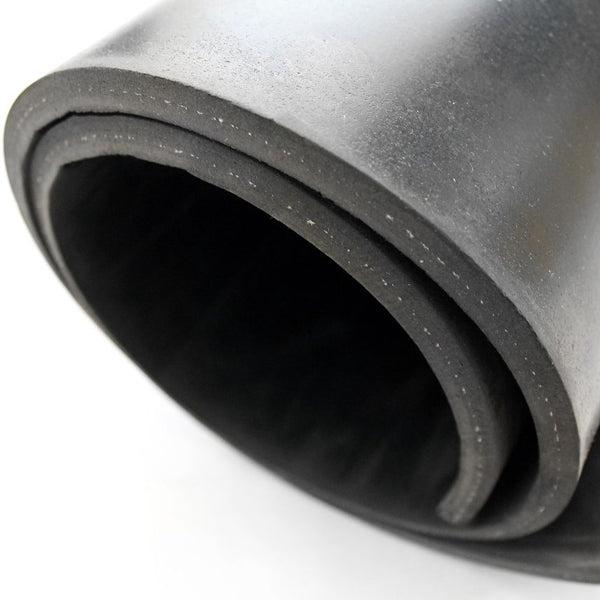
- High Strength: Designed for high compression load applications with a tensile strength of 3.4 MPa.
- Custom Sizes: Available in thicknesses from 1.8mm to 12mm and lengths up to 10 metres.
- Durable and Resilient: Features 70 Shore A hardness and elongation at break of 190%.
- Temperature Resistant: Operates between -30°C and +70°C for versatility.
From £28.02 + VAT
Always treat these values as part of the picture, not the whole picture. A sheet with a higher tensile figure is not automatically the best gasket, pad or liner for your job.
When insertion rubber is the right choice
Insertion rubber is usually worth considering when the job needs the sheet to resist excess stretch or hold its shape better during fitting and use. That often applies to gaskets, seals, pads and strips that are clamped, bolted, tensioned or repeatedly handled.
- Cut gaskets where you want more controlled movement during fitting
- Seals or strips that may otherwise stretch too easily during installation
- Pads or liners where dimensional stability matters
- Bench or surface protection where the sheet needs to be tougher in handling, provided the grade is suitable for that use
- Machine interfaces where the sheet is being compressed or fixed in place and movement needs to stay controlled
This does not mean reinforced sheet is automatically the right choice for flooring, anti-vibration use, waterproofing or pressure-critical sealing. Those are application-specific decisions and need technical data for the exact grade.
When not to choose insertion rubber first
Do not start with insertion rubber if the main challenge is exposure to weather, ozone, oils or chemicals. Start with the right rubber type first, then decide whether reinforcement is still needed.
For example, EPDM Rubber Sheet Rolls may be more relevant where weathering or outdoor conditions are the main concern.
EPDM Rubber Sheet Rolls (EPDM and SBR) 1.5mm to 6mm
First Mats recommendationEPDM Rubber Sheet Rolls: Versatile, Resilient, Customisable EPDM Rubber Sheet Rolls: This versatile and adaptable EPDM sheet material is perfect for a wide range of applications, including seals, o-rings, glass-run…
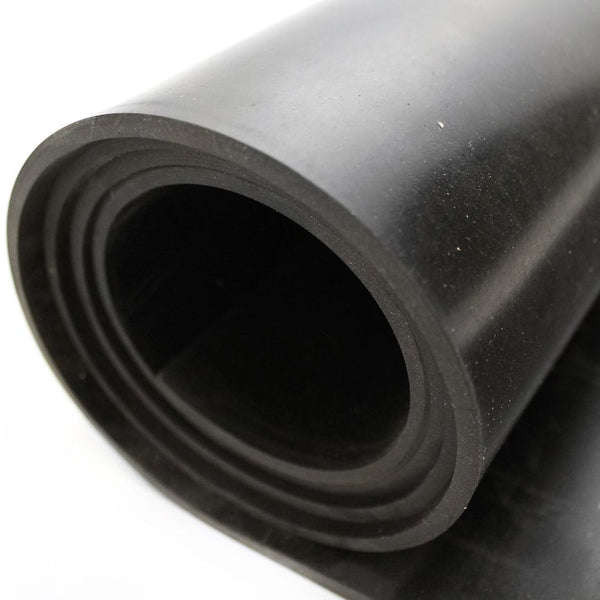
- Weather Resistant: Withstands ozone, oxidants, water, and harsh outdoor conditions.
- High Durability: 67 Shore A hardness and 5.0 MPa tensile strength for demanding applications.
- Flexible and Resilient: 300% elongation at break for enhanced stretchability.
- Custom Sizes: Available in thicknesses from 1.5mm to 6mm and lengths up to 10 metres.
From £27.07 + VAT
Neoprene Rubber Sheet Roll may be the better starting point where oil resistance or broader environmental resistance is more relevant than simply reducing stretch.
Neoprene Rubber Sheet Roll (CR and SBR) 3mm to 25mm
First Mats recommendationNeoprene Rubber Sheet Roll: Durable, Resistant & Versatile Neoprene Rubber Sheet Roll: A robust and versatile material, this sheet roll is perfect for applications requiring high resistance to mineral oils,…
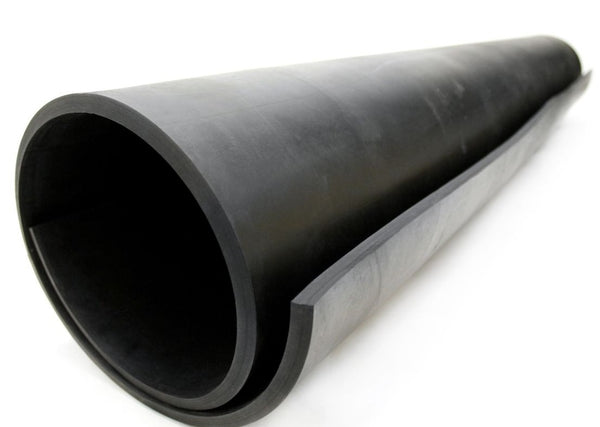
- Highly Resistant: Withstands heat, chemicals, oils, fire, and ozone.
- Weatherproof: Excellent ageing and weathering properties for outdoor use.
- Durable Material: Tensile strength of 6.0 Mpa and elongation at break of 250%.
- Custom Sizing: Thicknesses from 1.5mm to 25mm and widths of 140cm.
From £33.63 + VAT
What to check before you buy
A quick shortlist process helps avoid buying on category name alone.
- Define the job. Is the sheet sealing, protecting, spacing, lining or acting as a pad?
- Check whether reduced stretch is actually needed. If the material will be clamped, bolted or pulled during fitting, reinforcement may help.
- Choose the base rubber type. Environment can be the deciding factor before reinforcement is even considered.
- Confirm thickness. Thickness affects flexibility, fit and handling.
- Ask about reinforcement construction. One insert and multiple plies will not behave the same.
- Check the finish and cutting requirement. Make sure the sheet suits how you will cut and fit it.
- Verify technical data for the exact grade. Do not rely on the word insertion alone to predict performance.
Questions worth asking the supplier
- What is the base rubber compound?
- How many reinforcement layers does it have?
- Will the sheet stay flexible enough for the shape I need?
- Is the grade suitable for my environment, including oils, weathering or general exposure?
- Can it be supplied in the thickness and cut size I need?
If you need to compare options across the full range, the rubber sheeting collection is the best place to check available grades, thicknesses and formats.
A simple way to decide
If your main problem is too much stretch, distortion during fitting, or poor dimensional stability, insertion rubber is worth a proper look. If your main problem is the environment, start with the right rubber grade first and only then decide whether reinforcement adds real value.
Match the sheet to the job, not the label, and verify the exact grade before you order.