Advice
Does Decking Matting Need to Be Anchored Down?
Decking matting does not usually need to be permanently anchored if it is a heavy outdoor product designed to sit securely as a loose-lay system. What matters is not a blanket rule but whether the mat stays flat, resists movement and does not create an edge hazard in your actual site conditions. This guide explains what keeps outdoor matting in place, when fixing becomes the safer choice, and how timber, composite, slope, weather and traffic change the answer.

A wet deck outside an entrance, terrace or link corridor is exactly where this question comes up. In many cases, decking matting can be used loose-lay rather than permanently anchored, especially when it is a heavy outdoor mat designed to stay put under its own weight and underside grip. Get that judgement wrong and the mat can shift, lift at the edge or turn a slippery route into a trip point. This guide explains what keeps decking matting in place, when fixing is worth doing, and how to choose safely for timber or composite decking.
What actually decides whether you need to anchor it
The short practical answer is site conditions. There is no simple rule that says every deck mat must be drilled down, and there is no safe rule that says none of them ever should be.
UK slip and trip guidance focuses on whether the floor is suitable, in good condition and free from hazards, rather than on one fixed installation method. If a loose-laid mat stays flat, stays in position and does not create an obstruction, it may be suitable. If it can creep, curl, lift or leave an exposed edge, it needs securing or replacing with a better system. You can see that general approach in HSE guidance on flooring suitability and slip and trip prevention.
That is why many buyers prefer loose-lay outdoor matting where it works. It is quicker to fit, easier to lift for cleaning and does not force you to drill into decking boards unless the location really justifies it.
What keeps outdoor decking matting in place
Loose-lay deck matting stays put through a mix of weight, contact with the deck surface and the way the mat is made. Heavy rubber matting tends to settle better than lighter products because it has more mass and more surface area in contact with the boards.
The underside matters too. A mat with a grippy underside or a broad contact area will usually hold its position better on a relatively level deck than one with little surface contact. Some outdoor systems also use interlocking sections, which helps stop individual pieces spreading apart under foot traffic.
Drainage changes things as well. Outdoor matting that lets water and dirt move through or away is less likely to sit on a film of contamination. That does not make it automatically secure, but it does help the mat work as intended in exposed conditions.
Do heavy rubber mats stay secure on timber or composite decking?
Often, yes, but not in every setting. Heavy rubber mats often stay well positioned on flat, clean timber or composite decking when the surface is reasonably even and the route is mainly foot traffic.

The caution is that timber and composite do not behave the same way all year round. Moisture, algae, grit, cleaning residue and surface texture can all reduce grip. A deck that feels fine in dry weather may behave very differently after rain or leaf fall. So it is safer to treat loose-lay performance as something you confirm on site, not something you assume from the material alone.
When anchoring is recommended
Anchoring becomes the sensible option when the risk of movement is higher or the consequence of movement is more serious. The clearest test is simple: if the mat could shift, lift or create an edge hazard, secure it or change the specification.
That lines up with wider UK advice to remove or secure loose mats where they may become a trip risk, including NHS guidance on reducing slips and trips.
Site conditions that push you towards fixing
- Sloped or ramped decking where gravity encourages the mat to creep
- Wind-exposed terraces, rooftops or open-sided walkways
- Narrow routes where shoe traffic regularly catches the mat edge
- Very busy public access points with constant footfall
- Areas with trolleys, bins, wheeled equipment or furniture being dragged across the surface
- Installations made from separate sections that may spread apart over time
- Places where a moved mat would create a higher-risk incident, such as a care setting or school route
If any of those apply, a loose-laid mat may still be possible, but it needs closer scrutiny. In some cases the better answer is a heavier mat, a different format, or a product designed to be pegged or otherwise restrained rather than permanently fixed to the deck.
When loose-lay is usually not the best choice
Loose-lay matting is often the wrong fit for exposed ramps, routes with regular wheeled traffic, or places where cleaning teams constantly move the mat and put it back in a slightly different position. It is also a poor choice if the deck surface is uneven enough to leave rocking corners or lips.
What you are trying to avoid is the half-secure installation that looks fine at handover but starts to drift in daily use.
Fixing options and whether they can damage the decking
If anchoring is needed, the best method depends on whether the deck can be drilled, whether the installation is temporary and how often the mat must be lifted for cleaning.
Permanently fixing through the mat and into the deck may be appropriate in some settings, but it can affect the decking surface and make later changes harder. That is why buyers often look for non-permanent restraint first, especially on finished terraces or areas where the deck warranty or appearance matters.
Non-permanent approaches can include choosing a heavier mat, using an interlocking format, changing the layout so edges are less exposed, or using a product designed to be pinned into adjacent ground rather than fixed into the deck itself. The right answer is the one that keeps the mat stable without creating a maintenance problem.
If your route continues off the deck and onto grass or loose ground, SiteStep Walkway Matting Roll is useful because it is built as an outdoor route system and has optional ground pegs in its range. That makes it more relevant for transitions and temporary external paths than for a deck area that needs drilling.
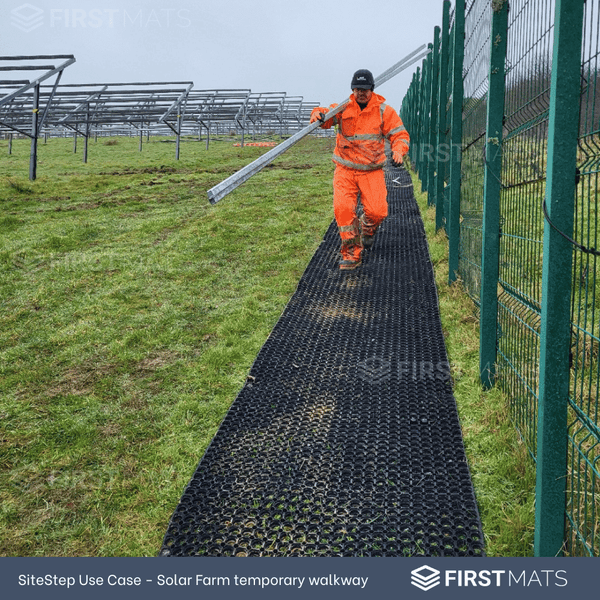
SiteStep Walkway Matting Roll
The SiteStep Walkway Matting Roll is the ultimate solution for creating clean, safe, and defined walkways across grass, gravel, and other uneven outdoor surfaces. Ideal for temporary footpaths at events,…
- Slip-Resistant Surface: Improves safety on grass, gravel, and uneven ground.
- Mud-Scraping Holes: Help remove dirt and debris from footwear.
- Durable Rubber: Built to endure heavy foot traffic and outdoor conditions.
- Portable Format: Supplied in a roll for easier transport and deployment.
From £24.50 + VAT
Before fixing anything, check the decking owner's guidance and the mat manufacturer's fitting advice. A secure installation matters more than the idea of anchoring on its own.
How to choose decking matting that will stay in place safely
Start with the route, not the product label. Look at how flat the deck is, how exposed it is to rain and wind, how people use it and whether the mat will ever see wheels rather than just shoes.
Then check four things:
- Weight and format – heavier rubber and broader contact with the deck usually help stability.
- Underside and surface design – the mat should sit flat and suit wet outdoor use.
- Edge behaviour – the edges should not curl, rock or sit where traffic can catch them.
- Cleaning reality – the mat should be easy to lift, clean and replace in the same position if you are not fixing it down.
If you are comparing general-purpose rubber for a flatter decked area, Wide Ribbed Rubber Matting Roll is one to review where you want a continuous rubber surface that can be cut to the route length. It suits buyers who need to cover a straight run on outdoor boards and want to assess whether extra restraint is needed at the edges rather than commit to a fixed panel system.
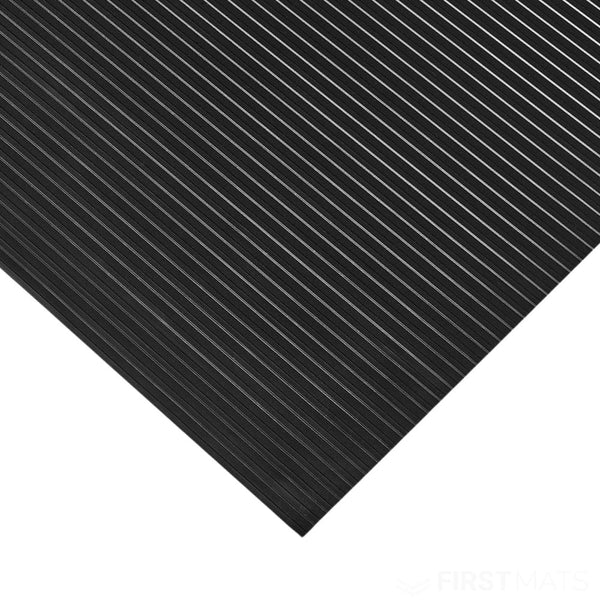
Wide Ribbed Rubber Matting Roll
The Wide Ribbed Rubber Matting Roll is a tough and versatile product designed for workshops, farms, garages, and outdoor areas. Its wide ribbed surface provides excellent grip while also allowing…
- Slip-Resistant: Wide ribbed surface ensures excellent traction in wet and dry environments.
- Durable Construction: Made from natural rubber for long-lasting performance.
- Custom Sizes: Available in widths of 90cm or 120cm, and lengths up to 10 metres.
- Multiple Thickness Options: Choose between 3mm for general use or 6mm for heavy-duty applications.
From £79.80 + VAT
For schools, estates routes and other outdoor pedestrian links where the path may move beyond the deck itself, it can also be worth looking at the wider walkway matting collection or, for entrance-adjacent areas, the outdoor rubber door mats range.
In education settings or similar public-facing sites, School Outdoor Walkway Matting Roll is a practical option when the decked section forms part of a longer external route and you need something made for outdoor pedestrian use, with peg options available where the path continues onto surrounding ground.
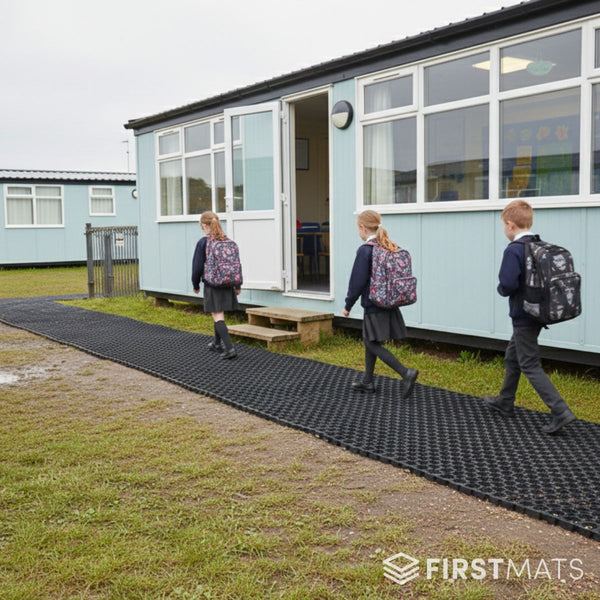
School Outdoor Walkway Matting Roll
The School Outdoor Walkway Matting Roll is designed to improve safety and accessibility across school grounds where grass, mud, and uneven surfaces are a daily challenge. It's particularly well suited…
- Stabilises Soft Ground: Can be partly submerged for permanent use.
- Durable Rubber: Designed to withstand all weathers.
- Slip-Resistant Surface: Reduces the risk of slip accidents.
- Mud-Scraping Holes: Keeps walkways cleaner and safer.
From £24.22 + VAT
A simple buying decision for UK sites
Most decking matting does not need permanent anchoring just because it is outdoors. It needs to stay flat, stay where you put it and stay safe in the conditions you actually have.
If your deck is flat, reasonably sheltered and used mainly by pedestrians, a suitable heavy outdoor mat may work well as loose-lay. If the area is exposed, sloped, high traffic or edge-sensitive, build anchoring or another restraint method into the spec from the start. If you are unsure, test the mat in place before ordering the full run and choose the installation method that leaves no doubt.