Buying Guides
Why Install Walkway Matting on Grass?

Slips and trips account for 40% of reported major injuries in HSE guidance, so a muddy grass route is not something to leave to chance. If guests, staff or visitors keep crossing the same lawn or field edge, walkway matting may help create a more defined path, reduce the mess carried indoors and make the route easier to manage.
That said, matting is not a cure for every outdoor surface problem. It works best when you first look at the actual issue: is the aim to limit wear, deal with mud, guide foot traffic, or create a temporary route for an event? The right answer depends on how firm the ground is, how long the route will stay in place and whether the traffic is pedestrians only or includes light wheeled movement.
Why people use walkway matting on grass
On grass, the usual problem is not just appearance. Repeated footfall can turn a route into a worn strip, especially in wet weather or on softer ground. Once that happens, people often spread out to avoid the worst patches, which can widen the damaged area and make the route less predictable.
Walkway matting can help by marking out one clear line of travel. That matters because HSE guidance on trips and uneven surfaces points to obstructions and poor walking surfaces as common causes of incidents. A defined path does not remove risk on its own, but it can be a sensible control measure where grass has become unreliable underfoot.
Matting may also help where you want to keep people off the weakest parts of a lawn, manage muddy tracking near entrances or make a temporary event route easier to follow. The main point is practical control. You are giving people a route that is easier to identify and maintain than bare grass.
When matting makes sense on grass
Walkway matting is usually most useful on reasonably level grass that has become worn, damp or messy, but is still basically stable underneath. In those conditions, the mat can sit as a surface layer that helps manage traffic rather than trying to compensate for major ground failure.

This fits with HSE guidance on temporary and unprepared routes, which says routes should still be suitable for purpose, firm, even and properly drained. That is a helpful test when you are deciding whether matting is appropriate. If the grassed area broadly meets those conditions, matting may be worth considering. If it does not, the problem may be bigger than a walkway product can fix.
Good candidates for walkway matting
- Temporary pedestrian routes for events
- Repeated foot traffic across lawns or landscaped areas
- Short access paths where mud is building up near entrances
- Defined routes that need to be quick to lay and remove
Where matting is likely to struggle
- Deeply saturated ground that shifts underfoot
- Rutted or highly uneven surfaces
- Areas with standing water or poor drainage
- Routes that need regular vehicle access or heavier loads
If the ground is very soft, the mat may move, sink locally or follow the shape of the surface below. That can reduce the benefit of installing it in the first place. In those cases, a heavier-duty access system may be more realistic than rubber walkway matting.
Standard Ground Protection Tiles - 40 Tonne are the sort of option to review when the route has moved beyond a footpath problem and into a broader access issue, especially if the site team is assessing more demanding outdoor traffic rather than simple pedestrian flow.
Standard Ground Protection Tiles - 40 Tonne
First Mats recommendationThe Standard Ground Protection Tiles provide a reliable way to turn soft or uneven ground into stable parking and access areas for festivals and outdoor events. Each extra-large mat supports loads…
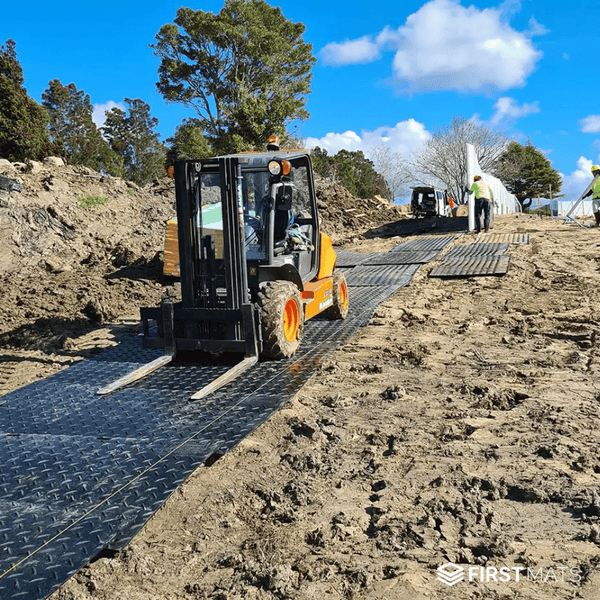
- Slip-Resistant Surface: Improves safety on grass, gravel and uneven ground.
- Heavy-Duty Load Capacity: Supports up to 40 tonnes for cars and vehicles.
- Dual-Sided Design: One side for pedestrians, one for vehicles with maximum traction.
- Easy to Handle: Integrated hand holes allow quick lifting and positioning.
From £11.39 + VAT
Before moving to a heavier panel system, it is worth being clear that this is a different category of product from pedestrian walkway matting. The choice should come from site conditions first, not from trying to force one format to do every job.
Rolls vs tiles on grass
The most useful way to compare rolls and tiles is by installation style rather than by asking which is better in general. Technical guidance on rubber matting formats shows that rolls and interlocking tiles are used differently, with edging and joins affecting how tidy and safe the finished route feels.
Choose rolls for long, simple routes

Rolls tend to suit straight or gently curved paths where you want a continuous run with fewer joins. They are often the easier format for short-term events because you can unroll them along the route, lift them afterwards and store them for reuse if the condition remains serviceable.
SiteStep Walkway Matting Roll is worth considering if your main concern is a temporary pedestrian path across grass that needs to be laid out quickly in one continuous line, especially for entry routes, queue lines or links between temporary event areas.
SiteStep Walkway Matting Roll
First Mats recommendationThe SiteStep Walkway Matting Roll is the ultimate solution for creating clean, safe, and defined walkways across grass, gravel, and other uneven outdoor surfaces. Ideal for temporary footpaths at events,…
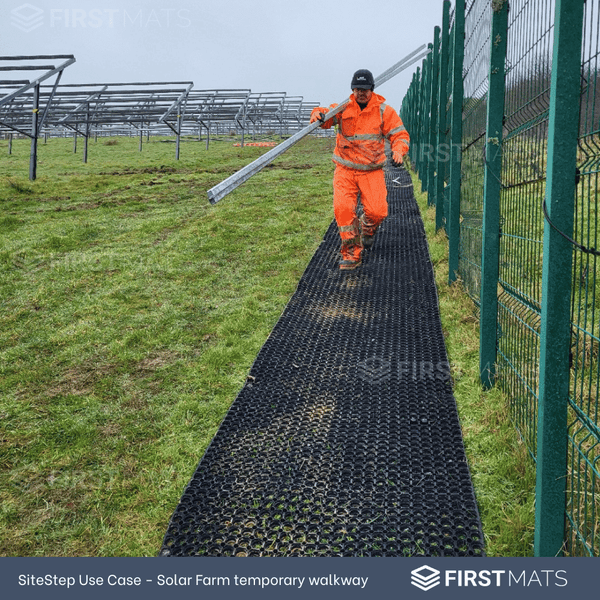
- Slip-Resistant Surface: Improves safety on grass, gravel, and uneven ground.
- Mud-Scraping Holes: Help remove dirt and debris from footwear.
- Durable Rubber: Built to endure heavy foot traffic and outdoor conditions.
- Portable Format: Supplied in a roll for easier transport and deployment.
From £24.50 + VAT
Rolls are less convenient where the path shape is awkward or where you only need to cover isolated worn spots. They also need careful checking at the ends and along the sides so the route does not finish with raised edges or local movement.
Choose tiles for modular coverage
Tiles can make more sense when the route turns corners, needs patch repairs, or may change shape from one use to the next. Smaller sections can also be easier to handle on site than one longer roll. If one part of the route takes more wear, replacing a section may be simpler than lifting an entire run.
Rubber Grass Protection Mats may suit landscaped areas or lawns where you need a route that can be built in sections, pinned or connected as needed, and adjusted around features rather than laid as one uninterrupted strip.
Rubber Grass Protection Mats
First Mats recommendationRubber Grass Protection Mats provide an effective way to reinforce soft or worn ground across parks, leisure areas, outdoor car parks, events and general public spaces. Made from durable natural…
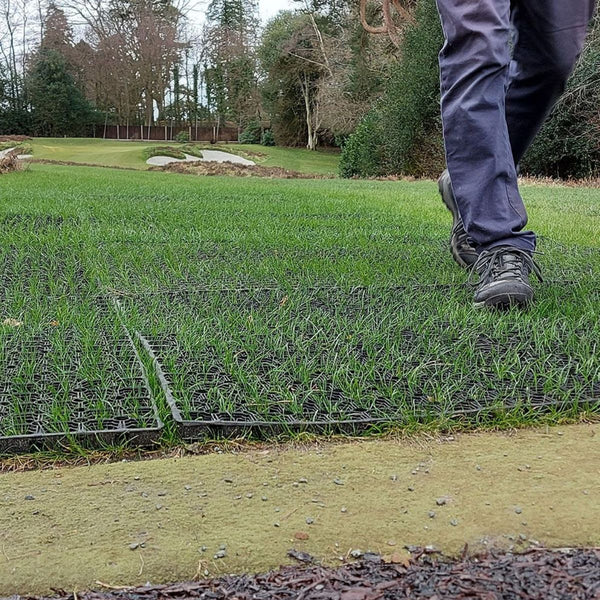
- Stabilises Soft Ground: Can be partly submerged for permanent use.
- Durable Rubber: Designed to withstand all weathers.
- Slip-Resistant Surface: Reduces the risk of slip accidents.
- Mud-Scraping Holes: Keeps walkways cleaner and safer.
From £24.50 + VAT
Tiles still need the same discipline around joins, edges and ground condition. More sections can mean more flexibility, but it also means more points to inspect once the route is in use.

What to check before you buy
Measure the route properly
Start with length and width, but do not stop there. Look at pinch points, corners, gateways and where people step on and off the mat. A route that is technically long enough can still feel awkward if it narrows too much or ends just before the muddy area actually finishes.
Think about drainage, not just the top surface
Perforations or open patterns may help water and debris pass through, but performance still depends on the ground below. If the soil is already saturated, the mat may simply sit over a weak base. This is why you should treat drainage as a site condition question, not just a product feature.
Check edges, joins and movement
Poorly finished edges can increase trip risk. The same applies to joins that separate or sections that creep out of line over time. If the route will stay down for more than a short event, check whether connectors, pegs or edge pieces are available and suitable for the layout you have planned.
SafePath High Visibilty Walkway Matting may be useful where route visibility matters, but it should only be chosen for grassed areas after checking that the ground is firm enough and that the product suits the exact environment rather than assuming any walkway mat will cope with mud or surface instability.
SafePath High Visibilty Walkway Matting
First Mats recommendationThe SafePath High Visibility Walkway Matting is the ultimate safety solution for construction sites and industrial environments. Designed from durable PVC, this matting ensures long-lasting performance while clearly marking pedestrian…
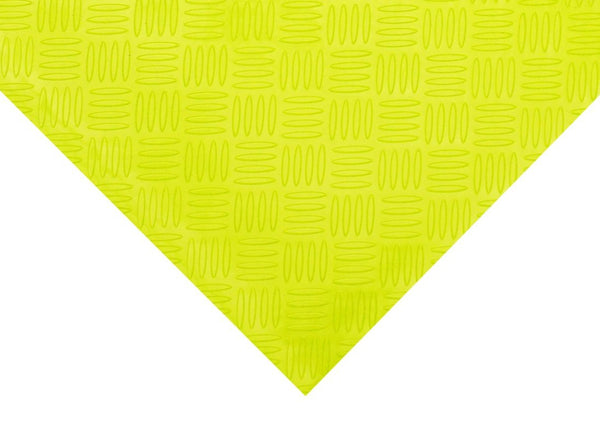
- High-Visibility Design: Bright yellow colour clearly marks walkways for improved safety.
- Durable Material: Manufactured from heavy-duty PVC for long-lasting performance.
- Weatherproof and Chemical-Resistant: Reliable for both indoor and outdoor environments.
- Low-Profile Surface: 2mm thickness ensures a trip-free design.
From £64.76 + VAT
Match the mat to the traffic
Pedestrian use is one thing. Light wheeled movement such as trolleys or buggies can place different demands on the route, especially at joins and edges. Do not assume a mat that works for foot traffic will automatically suit wheeled use. Check the current product information and assess the site in its real operating condition.
Plan removal and storage
For event use, think ahead to lifting, cleaning and storage. Mud, grass cuttings and moisture can add time at the end of the job. If the route is temporary, it is worth choosing a format your team can handle without turning removal into a separate access problem.
Suitable with checks, limited, or not the right system?
A simple way to decide is to sort the site into one of three categories.
- Suitable with checks: the grass is fairly level, reasonably firm and mainly needs route definition or mud management for pedestrians.
- Possible but limited: the route is soft in places, the weather is poor, or there may be some light wheeled movement, so joins, anchoring and edge management become critical.
- Use a different system: the ground is saturated, badly uneven or expected to take more demanding traffic than walkway matting is designed for.
For some outdoor areas, Playground Rubber Grass Mats may be worth reviewing where the aim is to reinforce a grass surface in sections rather than create a simple rolled path, particularly if the route is expected to stay in place beyond a one-off event and the ground needs more structured coverage.
Playground Rubber Grass Mats
First Mats recommendationPlayground Rubber Grass Mats provide a practical way to reinforce natural grass surfaces while maintaining a safe, child-friendly environment. Designed to stabilise soft ground, they prevent outdoor play areas from…
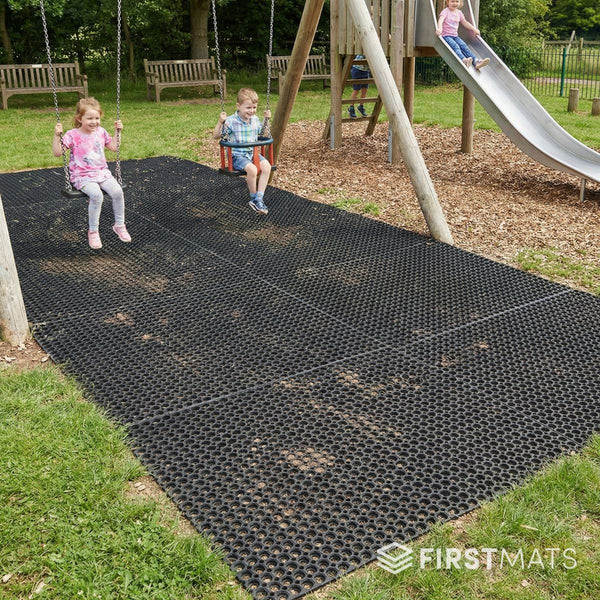
- Impact Resistant: Meets EN1177.2018 Critical Fall Height standards.
- Durable Rubber: Ideal for popular outdoor play areas.
- Slip-Resistant Surface: Reduces the risk of slips and falls.
- Stabilises Soft Ground: Can be partly submerged for permanent use.
From £24.50 + VAT
If you are still weighing up temporary access options more broadly, our guide on how to choose site matting for temporary access helps compare walkway matting with more robust access formats. Start with the ground condition, then choose the lightest system that still suits the route properly.