Buying Guides
How to Choose Site Matting for Temporary Access

Slips and trips are the most common cause of injury at work, according to HSE guidance on preventing slips and trips. If your route crosses mud, wet grass, soft ground or a surface you do not want to damage, temporary access matting can be a practical way to create a more usable path while protecting the ground beneath.
The key is to match the mat to the job. A pedestrian walkway for an event entrance is not the same thing as a panel system for service vehicles, and neither should be treated as a substitute for a true heavy-duty access route. Ground condition matters as much as the mat itself, so the best choice depends on what needs to cross the site, how poor the ground is, how long the route must stay in place and how the mats will be handled.
What temporary access matting is for
Temporary access matting is used to create short-term routes over soft, muddy, uneven or surface-sensitive ground. In practice, buyers usually want one or more of three outcomes: keep pedestrians moving, allow vehicles to pass with less ground disturbance, or spread load over a route that would otherwise cut up or fail.
Typical settings include construction sites, utilities work, landscaping jobs, event build areas, temporary compounds and overflow parking. The same broad product category covers very different formats, so it helps to separate walkway products, general ground protection panels and heavier roadway or trackway systems before you compare options.
If you are planning temporary parking as part of the route, it may help to review the wider temporary car park mat range alongside access products.
Understand the three main mat categories
Pedestrian walkway mats and rolls
These are typically used where people need a clear walking route over grass, gravel, mud or uneven outdoor surfaces. They suit event paths, short-term site walkways and access routes where the main traffic is on foot, sometimes with light hand-carried items or small wheeled movement depending on the surface and layout.

SiteStep Walkway Matting Roll is a sensible format to review when your route is mainly pedestrian and you want a continuous path that follows the line of a walkway rather than building it from separate rigid panels.
SiteStep Walkway Matting Roll
First Mats recommendationThe SiteStep Walkway Matting Roll is the ultimate solution for creating clean, safe, and defined walkways across grass, gravel, and other uneven outdoor surfaces. Ideal for temporary footpaths at events,…
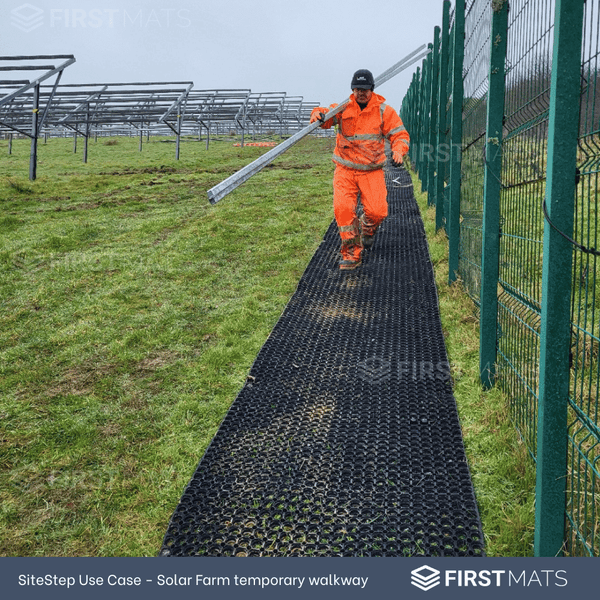
- Slip-Resistant Surface: Improves safety on grass, gravel, and uneven ground.
- Mud-Scraping Holes: Help remove dirt and debris from footwear.
- Durable Rubber: Built to endure heavy foot traffic and outdoor conditions.
- Portable Format: Supplied in a roll for easier transport and deployment.
From £24.50 + VAT
Rigid panels can still work for foot traffic, but rolls and rubber walkway products are often easier to plan for lawns, public-facing routes and spaces where a continuous walking line matters more than vehicle access.
General ground protection mats
This group sits in the middle. These mats are commonly used to protect grass, soft ground or prepared surfaces from lighter site traffic, service access or temporary parking use. They are often chosen when pedestrian products are too light for the task, but a full heavy-duty trackway system would be more than the site needs.

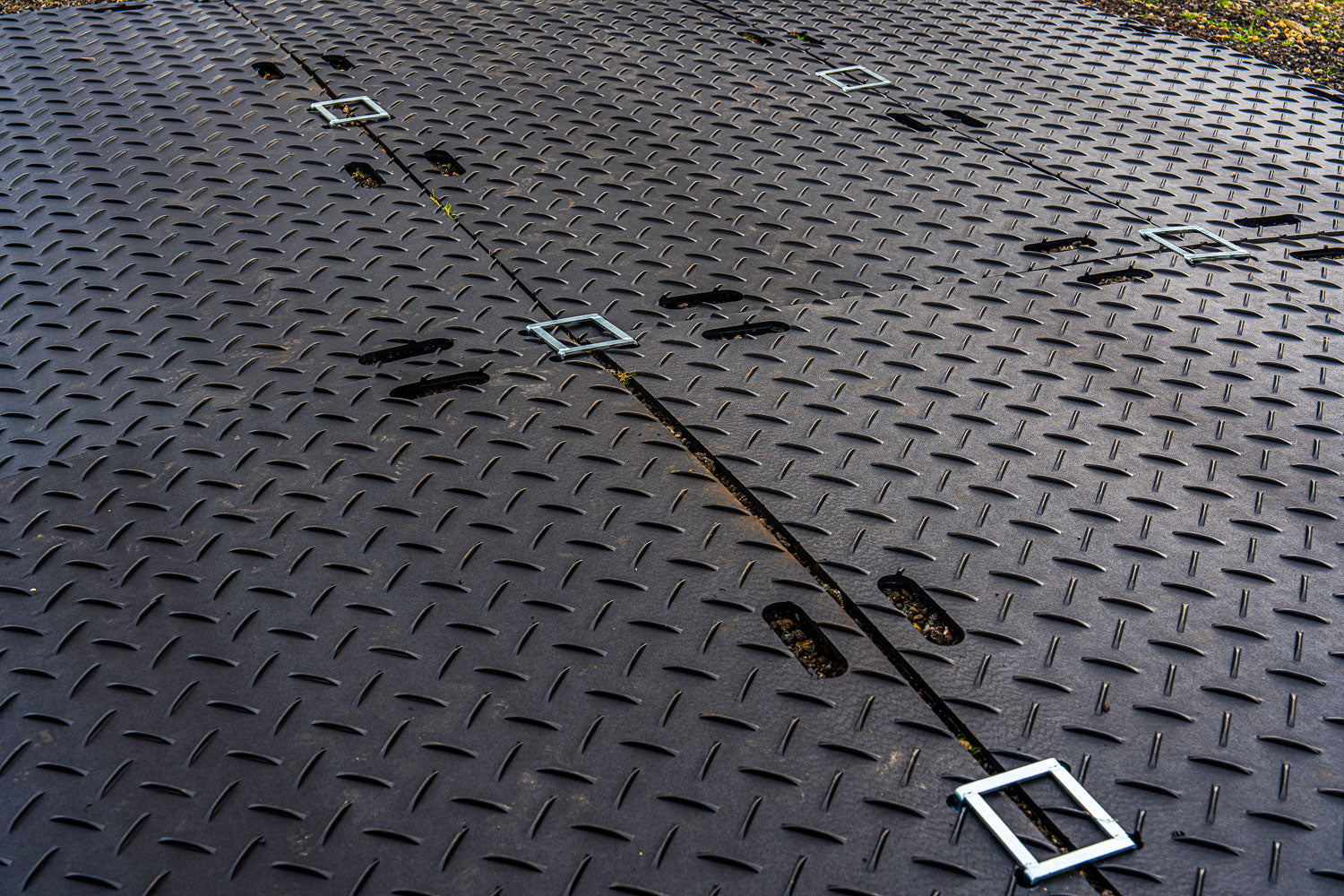
On event grounds, compounds or short vehicle routes where cars, vans or service traffic need support, Standard Ground Protection Tiles - 40 Tonne are the kind of panel system buyers often shortlist because they are aimed at access and parking use rather than footpaths alone.
Standard Ground Protection Tiles - 40 Tonne
First Mats recommendationThe Standard Ground Protection Tiles provide a reliable way to turn soft or uneven ground into stable parking and access areas for festivals and outdoor events. Each extra-large mat supports loads…
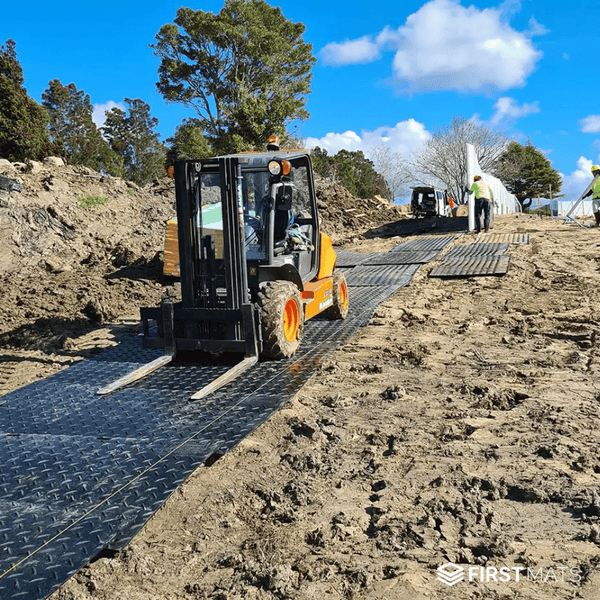
- Slip-Resistant Surface: Improves safety on grass, gravel and uneven ground.
- Heavy-Duty Load Capacity: Supports up to 40 tonnes for cars and vehicles.
- Dual-Sided Design: One side for pedestrians, one for vehicles with maximum traction.
- Easy to Handle: Integrated hand holes allow quick lifting and positioning.
From £11.39 + VAT
That said, published ratings must always be read with care. Supplier figures are usually ground-dependent, so a mat that suits one site layout may not suit another if the sub-base is weak, saturated or uneven.
Heavy-duty trackway and roadway-style systems
These are used where traffic is more demanding, the route may stay down longer, or the consequences of rutting and route failure are higher. They are generally considered where heavier vehicles or plant need access, but they still rely on suitable ground conditions and the manufacturer's stated use.

Heavy-Duty Ground Protection Tiles - 150 Tonne are more relevant when you are planning for tougher site traffic and need to look at connector options, panel layout and installation planning rather than simply laying a pedestrian route.
Heavy-Duty Ground Protection Tiles - 150 Tonne
First Mats recommendationProtect high-traffic surfaces with confidence using the Heavy-Duty Ground Protection Tile, a premium rigid mat built for demanding environments. Supporting loads of up to 150 tonnes and tested to 179…
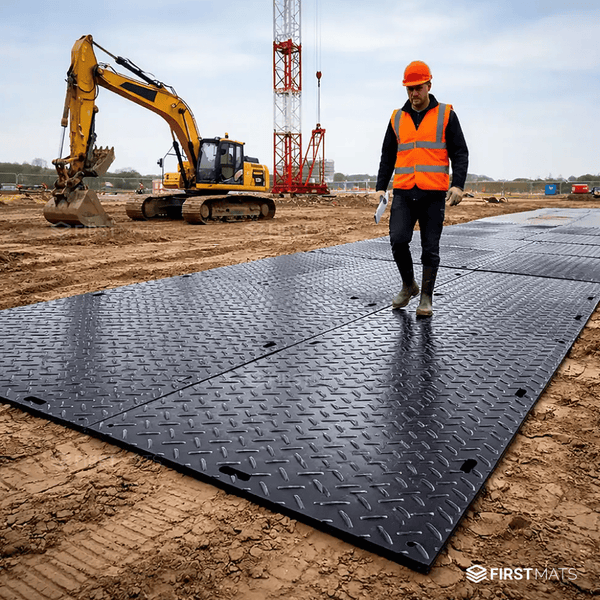
- Slip-Resistant Surface: Improves safety on grass, gravel and uneven ground.
- Heavy-Duty Load Capacity: Supports up to 150 tonnes for machinery and site vehicles.
- Dual-Sided Design: One side for pedestrians, one for vehicles with maximum traction.
- Easy to Handle: Integrated hand holes allow quick lifting and positioning.
From £11.39 + VAT
A heavier panel is not automatically the best buy. It may cost more, weigh more, need more organised installation and still require a proper site check before use.
Choose by traffic first, then ground
The quickest way to narrow the shortlist is to start with the heaviest and most demanding thing that must cross the route. Ask whether the route is for pedestrians only, pedestrians with trolleys or wheelbarrows, cars and vans, service vehicles, or heavier plant. If the route will carry mixed traffic, choose around the most demanding realistic use, not the average one.
Next, assess the ground. A firm, well-drained surface can support a wider choice of mats than saturated soil or churned grass. An academic review cited in the research pack noted that suitability depends on subgrade conditions, expected loads and deployment needs. This is why no mat should be treated as a universal answer for every site.
Use these rules of thumb:
-
Pedestrian-only routes usually point towards walkway rolls or rubber walkway products.
-
Mixed foot and light vehicle access often points towards general ground protection panels.
-
Regular vehicle movements or more demanding traffic usually call for heavier panel systems with planned layout and joining.
-
Very poor or saturated ground may still need extra preparation, a different route or a more robust system than first expected.
If you are unsure where the boundary sits, the safer approach is to shortlist by category, then confirm the exact product against supplier data rather than guessing from appearance alone.
Do not ignore duration, handling and joining
Some buying mistakes happen because the route is planned only around traffic, not around deployment. A mat that is suitable on paper can still be awkward if the team needs to hand-carry it long distances, reposition it daily or install it in a tight area without lifting equipment. HSE guidance on manual handling in construction also points to higher risk where floors are slippery, obstructed or uneven and recommends using mechanical aids where possible.
Duration and frequency of use
For a short event or brief maintenance visit, simple pedestrian or mid-duty systems may be enough if they suit the traffic. For repeated contractor access or a route that stays down through changing weather, durability, panel stability and connector choice become more important.
Connectors and layout
Not all panels join in the same way. Some systems offer different connector types, and that affects how the route is assembled, widened, repaired or lifted. Check whether connectors are included, optional, bolt-free or bolted, and whether they are specific to the product you plan to use.
Handling and storage
Check panel weight, shape and transport method before ordering. Some mats may be manageable by hand in the right setting, while others are better handled with equipment or a larger team. After use, think about how the mats will be cleaned, stacked, transported and stored so they stay suitable for future jobs.
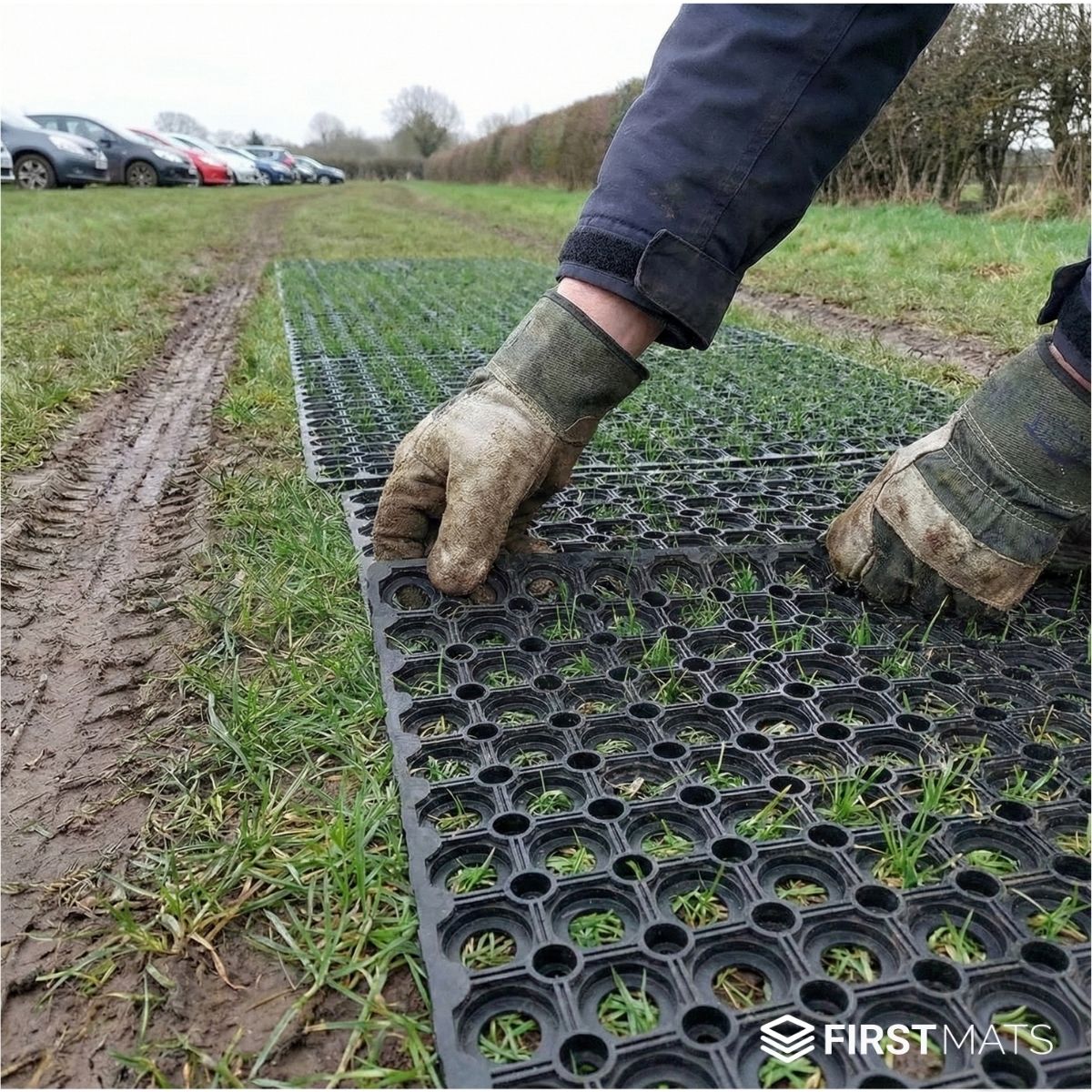
For softer landscaped areas, parks or lawns where preserving the surface matters as much as simple access, Rubber Grass Protection Mats may be worth comparing against rigid panels because they fit a different type of ground-protection need.
Rubber Grass Protection Mats
First Mats recommendationRubber Grass Protection Mats provide an effective way to reinforce soft or worn ground across parks, leisure areas, outdoor car parks, events and general public spaces. Made from durable natural…
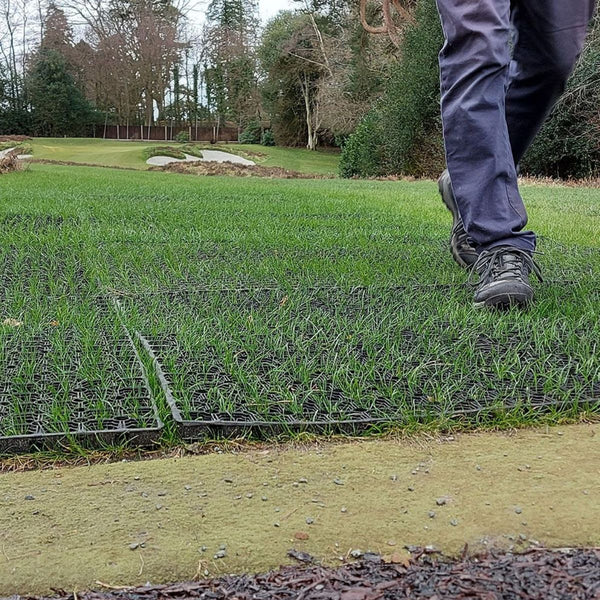
- Stabilises Soft Ground: Can be partly submerged for permanent use.
- Durable Rubber: Designed to withstand all weathers.
- Slip-Resistant Surface: Reduces the risk of slip accidents.
- Mud-Scraping Holes: Keeps walkways cleaner and safer.
From £24.50 + VAT
When rolls or rubber walkways are the better option
Buyers often jump straight to hard panels, but a rigid system is not always the best answer. If the route is mainly pedestrian, especially on grass or across an event site, a roll-out walkway or rubber surface can be easier to plan and more appropriate for the task.
This is often true where you need a clear entry route, a temporary public path, or a foot-only link between work areas. A walkway format can also make more sense where you want a defined path without building a wider vehicle-style track. If your project is close to demolition, site strip-out or changing ground conditions, our guide to ground protection and safety mats for demolition sites covers related planning points.
Where the need is broader vehicle access, compare against the wider ground protection mat range rather than assuming a walkway product will cope.
What to confirm before you buy or hire
Before you place an order, sense-check the shortlist against supplier data and the actual site. Always confirm:
-
the intended traffic type and whether the product is aimed at pedestrians, general vehicle access or heavier-duty use
-
the stated load rating and any caveat that it depends on ground conditions, route build-up or installation method
-
panel or roll dimensions, weight and how the mats will be moved on site
-
whether connectors are needed, included or product-specific
-
how long the route will stay in place and whether mats need to be repositioned or reused
-
whether the underlying surface is firm enough, too soft, sloped or otherwise unsuitable without extra preparation
If buying feels like overkill for a one-off project, hiring may be worth exploring, but the same checks still apply. Do not sign off a system based only on a headline rating or because a similar-looking mat worked somewhere else.
If you want to avoid both over-specifying and under-specifying, start with the real traffic, check the ground honestly, then verify the shortlist with supplier data before the site turns into a recovery job.