Buying Guides
DDA-Compliant Floor Matting: What to Choose (and Avoid) for Accessible Entrances

Floor mats are often treated as a finishing touch, but in reality they’re part of the access route. The wrong mat can become a trip hazard, snag a walking aid, or make it harder for wheelchair users to enter and move around a building. And if you’re responsible for a workplace, public building, retail unit, healthcare setting or multi-occupancy premises, that’s not just a usability issue, it can become a legal and health & safety risk.
As it's a topic we're asked about a lot at First Mats, this article explains what people commonly mean by “DDA compliant matting”, how the principles of the UK’s Disability Discrimination Act 1995 (DDA) and subsequent legislation affect mat selection, and what to look for in common mat types such as coir, matwell mats, rubber-backed loose-laid mats, and runners/rolls.
Note: This article is practical guidance, not legal advice. If you’re unsure, speak to your access consultant, building control body, or H&S lead.

First: the DDA and accessibility duties (what still applies today)
The DDA 1995 was landmark legislation for disability rights. In England, Scotland and Wales, its provisions were largely replaced and consolidated under the Equality Act 2010. The DDA still remains on the statute book in Northern Ireland. Because of that history, many people still use “DDA compliant” as shorthand for “designed so disabled people can access and use the building without substantial disadvantage”.
In practice, when you’re selecting floor matting for an entrance or main route, you’re aiming to support the same core outcome: safe, dignified, independent access.
If you want to read the legislative timeline in plain English, the House of Lords Library explainer on the DDA 1995 and what replaced it is a helpful overview.
There’s no such thing as “certified DDA-compliant” matting
A common misconception is that certain mats are officially “DDA compliant” or “non-compliant”. In reality:
- There isn’t a single UK-wide “DDA matting certificate”.
- Compliance is judged by whether the environment creates barriers and whether reasonable steps have been taken to remove them.
That’s why the same mat might be fine in one location and a problem in another — context matters.
The two frameworks you should design for
Equality Act: physical features include floor coverings
For many public-facing premises, the duty to make reasonable adjustments is anticipatory, meaning barriers should be considered and addressed before they cause disadvantage, not just in response to complaints.
The statutory Code of Practice makes it clear that physical features include floor coverings and even temporary or movable items. In practical terms, this means that loose mats, runners, or poorly maintained entrance matting can still form part of an accessibility barrier if they create trip hazards or make movement more difficult for disabled people.
For those responsible for buildings, this reinforces the need to think about matting as part of the access route, rather than just a housekeeping or finishing detail.
Reference: Equality Act 2010 Code of Practice
Building Regulations (Approved Document M)
Approved Document M provides practical design guidance for ensuring buildings can be accessed and used safely by disabled people. While it is not law in itself, it is widely used by designers, builders, and building control bodies as a benchmark for accessible design.
For entrance areas and circulation routes, Approved Document M places particular emphasis on:
- Ensuring floor surfaces do not impede wheelchair movement
- Avoiding changes in level that could create trip hazards
- Ensuring that where matwells are used, the mat surface is level with adjacent floor finishes
Crucially, Approved Document M also makes clear that compliance with Building Regulations does not automatically mean Equality Act duties have been met. In some cases, additional or alternative matting solutions may be required to remove barriers in real-world use.
Reference: Approved Document M: Access to and use of buildings
What accessible matting looks like in practice
- Lies flat and stays flat
- Does not impede wheelchair movement
- Does not introduce trip hazards
- Controls wet ingress
- Is easy to clean and maintain
- Does not visually confuse users
Slip and trip risk still matters
Accessibility is not only about wheelchair movement. Slips and trips can disproportionately affect people with reduced vision, balance, or mobility, making effective entrance matting a key part of overall risk management.
The HSE highlights entrance matting as a practical control for reducing slip risks caused by rainwater being tracked into buildings, while also stressing the importance of identifying and dealing with damaged or poorly performing mats.
In practice, this means matting should:
- Remove moisture effectively in wet conditions
- Remain flat and stable under foot traffic
- Be inspected and replaced when worn, curled, or damaged
Reference: HSE: Preventing slips and trips at work
Mat types under the spotlight
Not all floor mats perform the same when it comes to accessibility, safety, and compliance expectations. Below, we look in detail at the most common commercial mat types, how they interact with DDA / Equality Act principles, and when they should be specified — or avoided.
1) Coir matting
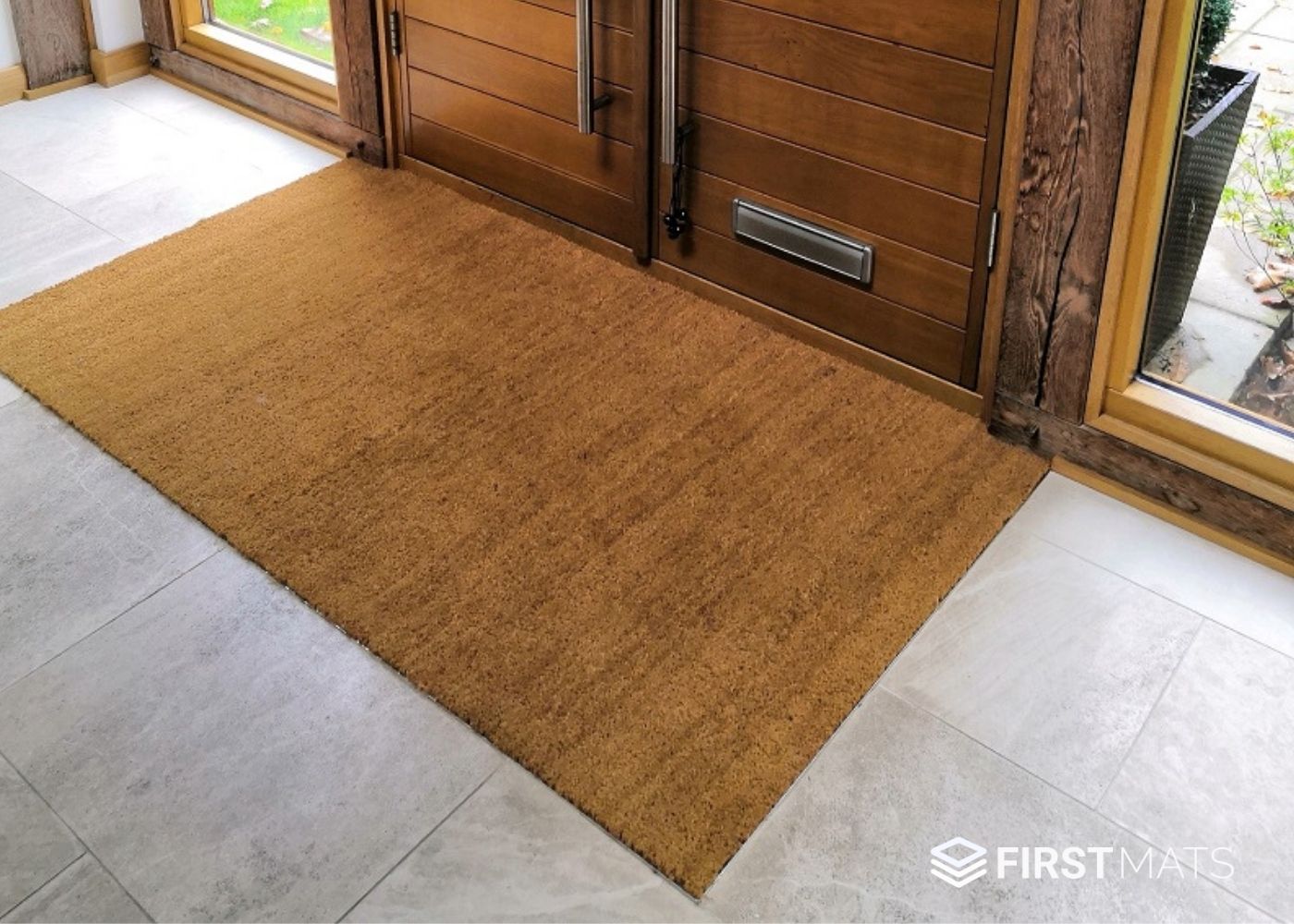
Coir matting is commonly used for its scraping performance and traditional appearance, but it presents several accessibility concerns in commercial and public buildings.
Approved Document M (Volume 2) specifically highlights coir as an example of an entrance surface that can impede wheelchair movement. Its coarse, flexible fibres increase rolling resistance and can make access difficult for wheelchair users, prams, and mobility aids. Surface-laid coir mats may also introduce trip hazards due to their thickness, movement, or curled edges, and their moisture-absorbing nature can reduce effectiveness in wet conditions.
Specification guidance:
Natural coir matting should generally be avoided on principal accessible routes. If used at all, it should only be installed in a recessed matwell, fitted flush with surrounding floor finishes, and maintained regularly. In most cases, a synthetic alternative or a different mat type will offer better support for inclusive access and DDA / Equality Act considerations.
2) Matwell mats (recessed entrance matting systems)
Recessed matwell systems are widely regarded as the best-practice solution for accessible commercial entrances, particularly in new-build projects or major refurbishments.
Approved Document M specifically states that where matwells are provided, the mat surface should be level with the adjacent floor finish. This directly addresses one of the biggest accessibility risks associated with entrance matting: raised edges.

Why matwell mats support accessibility:
- Flush installation: Eliminates trip hazards caused by proud edges or loose mats.
- Wheelchair-friendly movement: Properly specified matwell inserts provide a stable, dense surface that allows wheels to roll smoothly.
- Effective moisture control: High-performance inserts reduce water being tracked into the building, supporting slip-risk management.
- Clear, predictable transitions: Helps users with visual impairments navigate entrances without confusion.
Specification and installation considerations:
- Ensure the matwell depth exactly matches the mat thickness
- Avoid gaps where canes, heels, or small wheels could catch
- Choose inserts designed for high pedestrian and wheeled traffic
- Include matwell cleaning as part of the building’s maintenance plan
A poorly installed matwell (for example, one that leaves a lip or allows the mat to rock) can undermine accessibility, so this detail should be treated as part of the access strategy, not an afterthought.
Mat-Well Tile Plus - 18mm Thick Tiles
First Mats recommendationThe Mat-Well Tile Plus is a premium 18mm modular matting system, engineered for large commercial entrances where safety, durability, and appearance are critical. Designed for contractors and building designers, it…
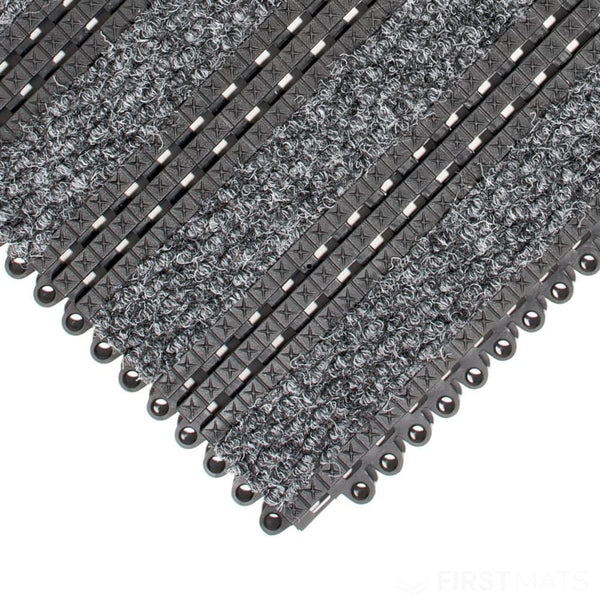
- High-Quality Carpet: Needle-punch carpet traps dirt and moisture efficiently.
- Fire Resistant: Certified to EN13501 for safety compliance.
- Custom Tile Options: Open or closed designs for tailored dirt management.
- Compact and Durable: 29cm x 44cm tiles with 18mm thickness.
From £25.69 + VAT
3) Rubber-backed loose-laid mats
Rubber-backed loose-laid mats are commonly used in existing buildings where forming a matwell is impractical. They can be a workable solution, but only when carefully selected and actively managed.
From an accessibility perspective, the main risk with loose-laid mats is movement. Even a mat with a slip-resistant backing can migrate over time, creating a trip hazard or narrowing an access route.

Rubber-backed mats are more likely to be suitable when they:
- Have a low-profile construction
- Include bevelled edges to reduce toe and wheel catches
- Are heavy enough to resist movement in high footfall areas
- Remain fully flat under traffic and cleaning
Common accessibility failures to watch for:
- Curling corners or lifted edges
- Mats that creep into door swings or circulation routes
- Undersized mats that slide easily and fail to control moisture
- Worn backing that no longer grips the floor surface
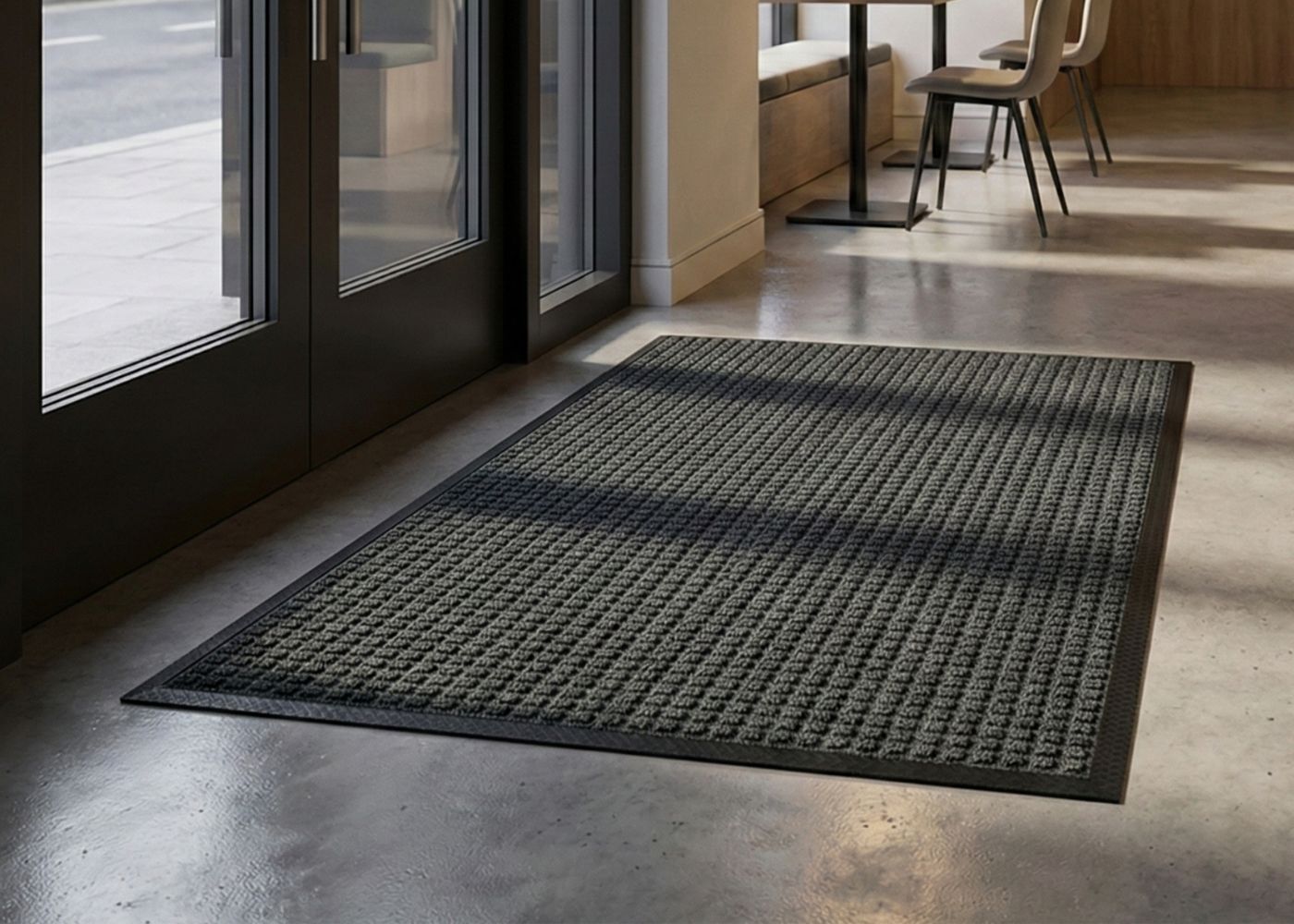
Our AquaProtect Entrance Mat has been tested for accessibility and is highly recommended by wheelchair users, thanks to its low-profile design and bevelled edges.
Facilities teams should treat loose-laid mats as a managed safety control. Regular inspection and prompt replacement are essential to prevent them from becoming an access barrier.
AquaProtect Super Absorbent Door Mat
First Mats recommendationThe AquaProtect Super Absorbent Door Mat is made for entrances that have to deal with wet weather, muddy shoes, and heavy daily footfall. Holding up to 6 litres of water…
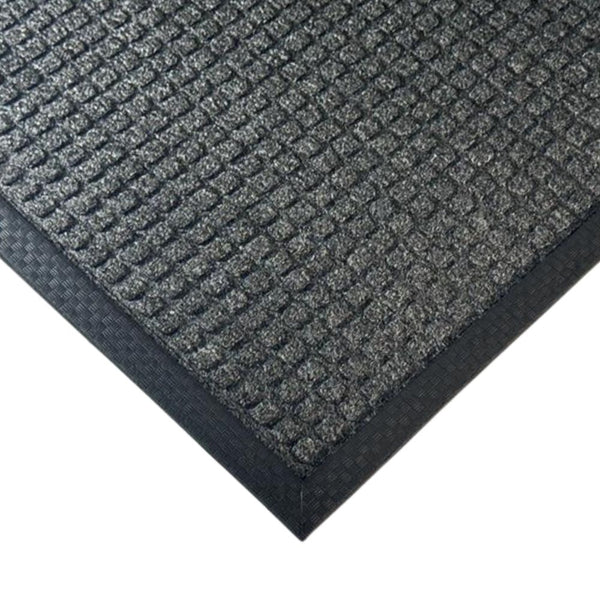
- Super Absorbent: Holds up to 6 litres of water per square metre.
- Highly Durable: 10.5mm thickness with Decalon fibres for long-lasting use.
- Non-Slip Design: Rubber backing prevents movement on smooth floors.
- Wheelchair Accessible: Reinforced border for added stability.
From £30.60 + VAT
4) Floor mat runners and rolls
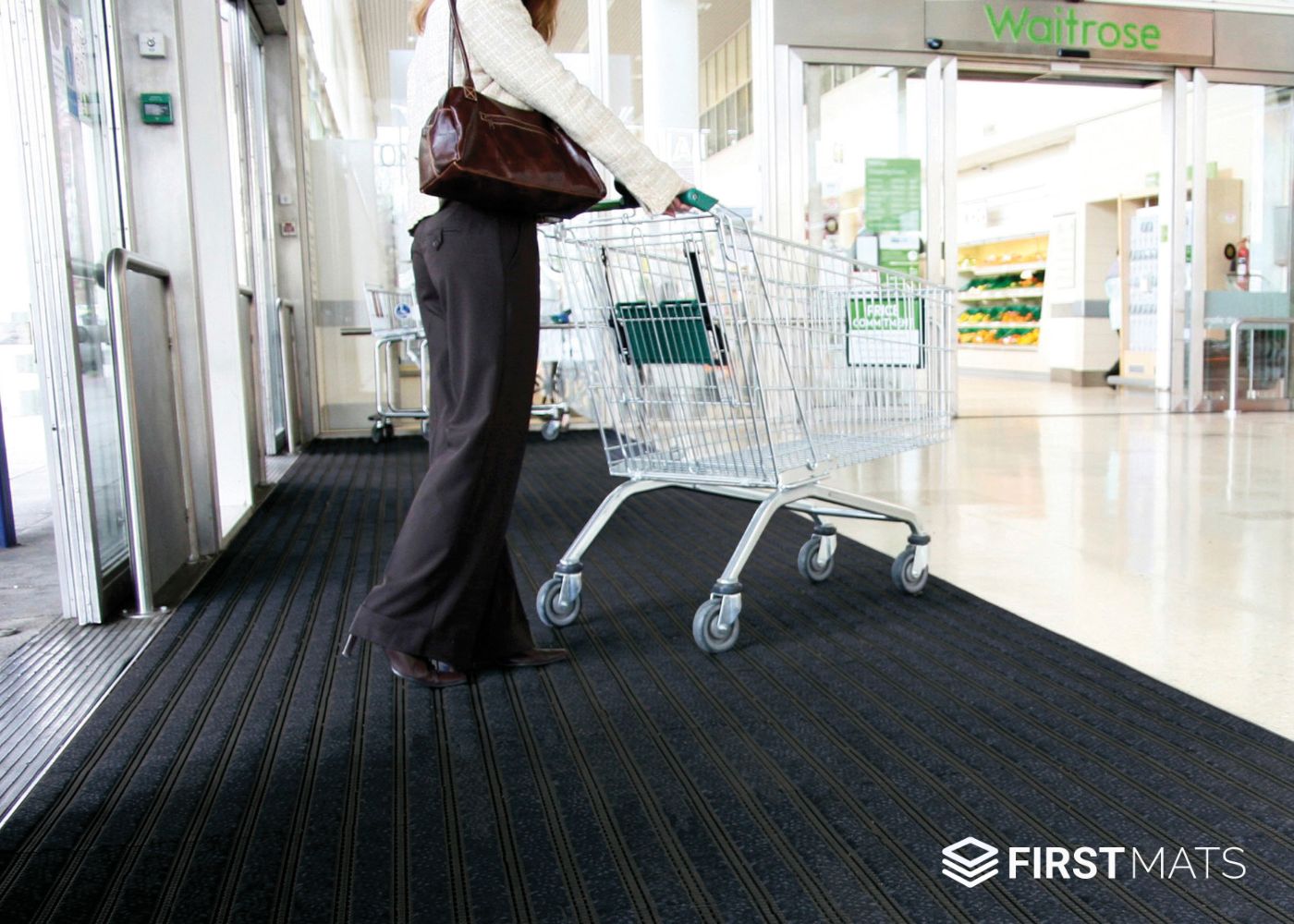
Floor mat runners and rolls are often used to extend protection beyond the immediate entrance, particularly in long lobbies or corridors. While they can be effective, they also present the highest potential risk if poorly specified or installed.
The longer a mat runs, the greater the chance of rippling, edge lift, or movement, all of which increase trip risk and can disadvantage disabled users.

Runners and rolls may be appropriate when they are:
- Properly secured to prevent creep and rippling
- Installed with flat, well-defined edges
- Wide enough to avoid funnelling foot traffic
- Kept clear of door thresholds and turning spaces
Runners and rolls should be avoided when they:
- Are used as temporary “throw-down” solutions in busy access routes
- Require ad-hoc taping that creates raised ridges
- Introduce changes in level at thresholds or landings
- Are left in place once they begin to ripple or fray
If runners are intended as a long-term solution, they should be specified and installed with the same care as any other fixed floor covering, not treated as a temporary accessory.
EntraNib Heavy-Duty Borderless Barrier Matting
First Mats recommendationThe EntraNib Heavy-Duty Borderless Barrier Matting is designed for high-traffic commercial entrances, corridors, and mat wells where safety, cleanliness, and a seamless finish are essential. With a robust nibbed pile…
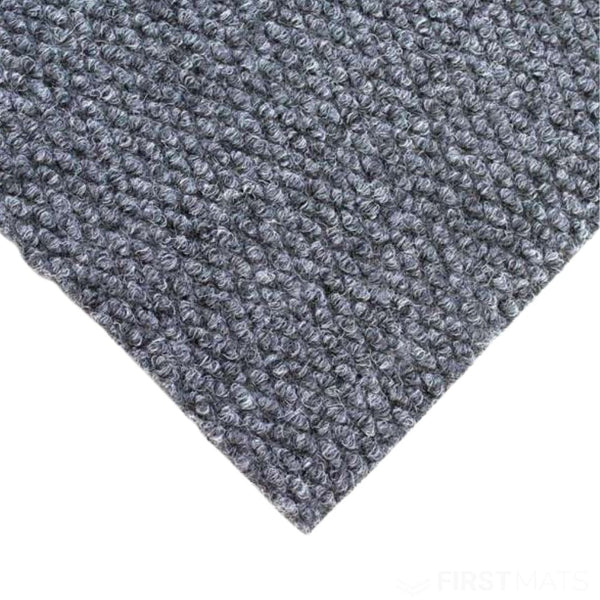
- Heavy-Duty Material: Made from solution-dyed polypropylene for durability.
- Effective Moisture Control: Absorption rated 4/5 for retaining water.
- High Soil Resistance: Rated 4/5 for trapping dirt and debris.
- Safety Features: Flame retardant, UV resistant, and slip-resistant.
From £91.81 + VAT
Quick checklist for accessible matting
- Is it flush or low-profile?
- Does it allow easy wheelchair movement?
- Will it stay in position?
- Does it reduce slip risk in wet conditions?
- Is there a maintenance plan?
Key takeaways
- “DDA compliant matting” is about outcomes, not labels.
- Coir is generally unsuitable for accessible entrance routes.
- Matwells offer the most robust accessible solution when installed correctly.
- Loose mats and runners require careful specification and ongoing management.
- Equality Act duties can go beyond Building Regulations.